· 2076 words · 10 min · Updated
🛢️ Ostium Review 2026 — Trade Oil, Gold, S&P 500 and Stocks From a Crypto Wallet: RWA Perps on Arbitrum, Vault Yield and Points Season 2
Ostium 2026 explained: perpetuals on oil, gold, forex, indices and stocks straight from a crypto wallet — USDC collateral on Arbitrum, opening fee only (no closing fee), up to 200x on supported markets, OLP vault yield and Points Season 2. Real interface screenshots and an honest look at synthetic perps risk.
Honest review. Some links are affiliate links: same price for you, a small commission for the project.
⚡ Short answer — what Ostium delivers in 2026
Ostium lets you go long or short on oil, gold, forex, the S&P 500 and single stocks from a crypto wallet — synthetic perpetuals on Arbitrum with USDC collateral, an opening fee but no closing fee, and leverage up to 200x on supported markets. Since launch it has cleared $51B+ in volume with 26K+ traders (per ostium.com, July 2026).
Be clear-eyed: these are leveraged synthetic perps — you trade price exposure, not ownership. The risk is leveraged too.
🚨 Update, 16 September 2026 — read before you act on this review. On 15 July 2026, 14:18–14:23 UTC, a compromised oracle key let an attacker push fake prices and drain 23,752,746 USDC from the OLP vault (post-mortem analysis · CoinDesk). Ostium halted trading the same day and reopened on 23 July 2026; the venue is operating now. This review was first published on 16 July — the day after the exploit — and did not mention it. That was our miss, and the sections below have been corrected rather than quietly edited. Compensation for affected OLP depositors: Ostium said it would make liquidity providers whole, and as of 16 September 2026 we found no official confirmation that this is complete. In its 30 July post-mortem Ostium said a recovery plan for LPs "is being finalized and will be shared in a separate post" (The Block); as of 16 September we found no such post on its blog, in its docs or in the news. Trading and depositing into the vault are now two different risks — see the OLP section. Next status check: 30 September 2026.
🛢️ Sign up on Ostium with my referral link
⚠️ Disclosure: this article contains a referral link to Ostium. If you sign up through it, I may earn a referral bonus at no extra cost to you — and the code gives a boost to your Points score. Ostium is responsible for its product and terms — verify current numbers in the app before funding meaningful amounts. This is educational content, not financial advice.
🖥️ What it looks like — a macro terminal in your wallet
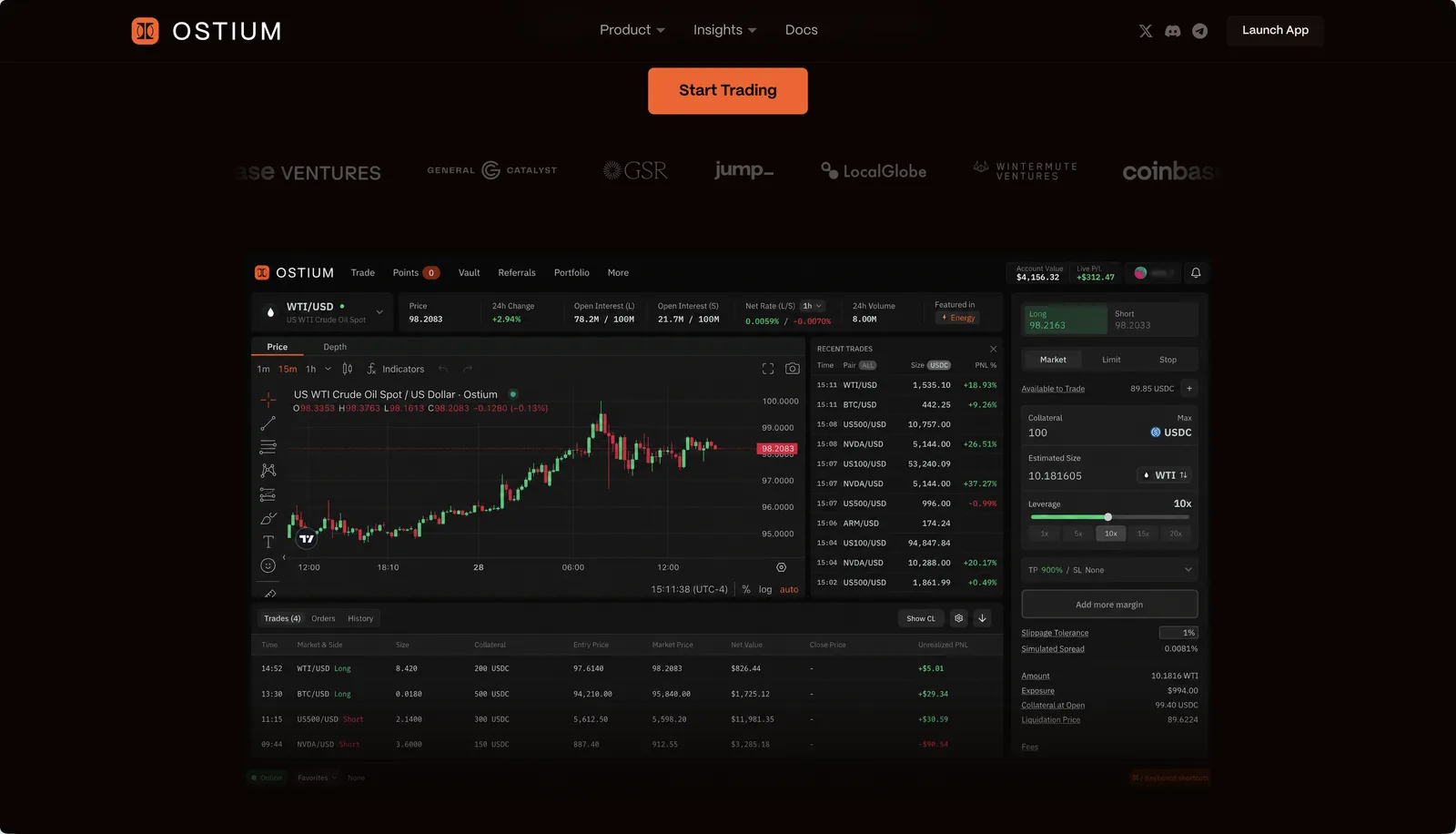
The terminal is instantly familiar if you've traded perps anywhere: TradingView chart, order book depth, market/limit/stop orders, TP/SL, leverage slider, and a trades tab with live unrealized P&L. The screenshot above (Ostium's live terminal preview) shows what a working book looks like — WTI and BTC longs next to US500 and NVDA shorts, all margined in the same USDC balance.
That's the actual pitch: macro and crypto on one screen. No broker account for the oil trade, no separate CFD platform for the index short — one wallet, one collateral, one interface.
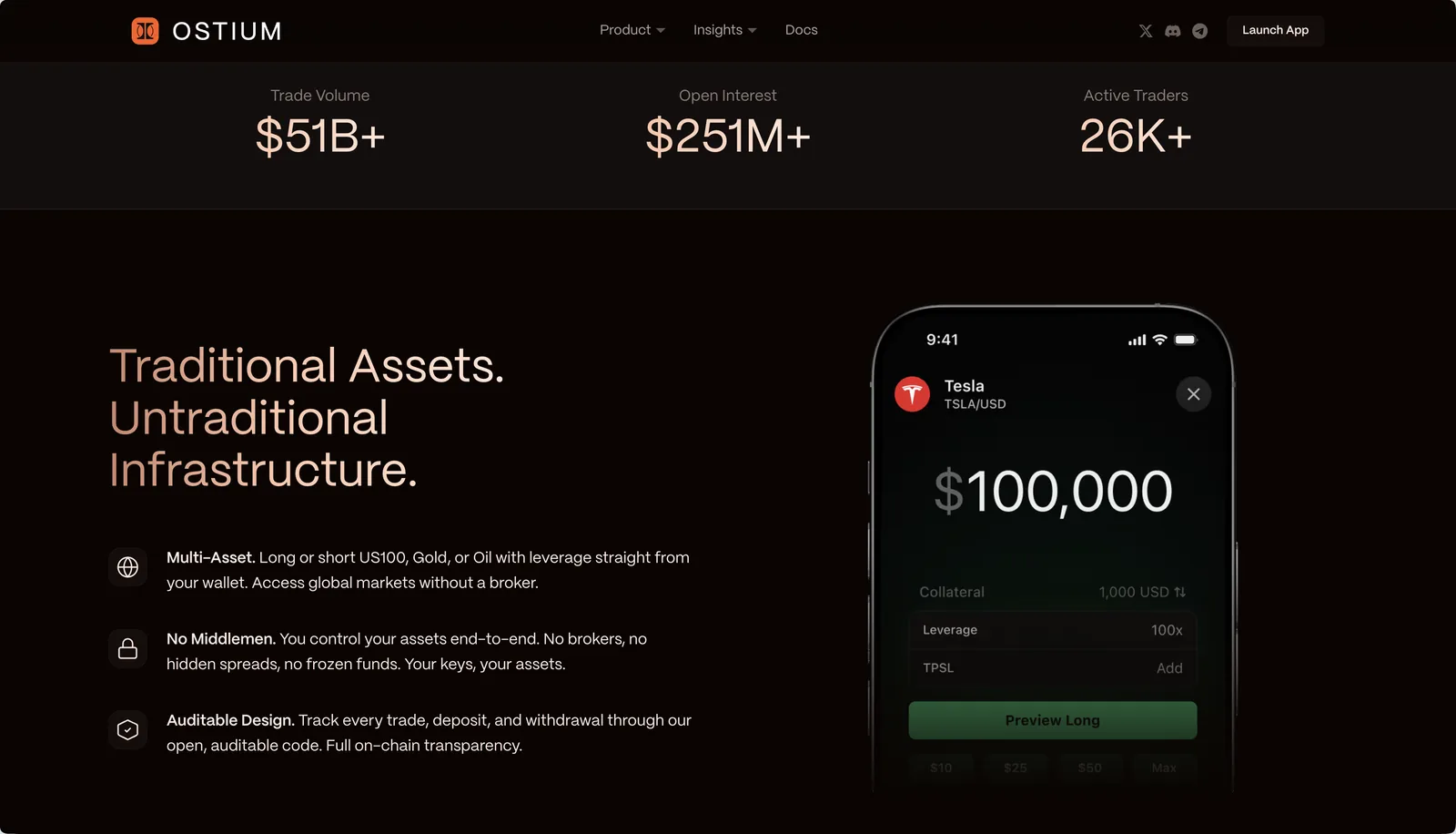
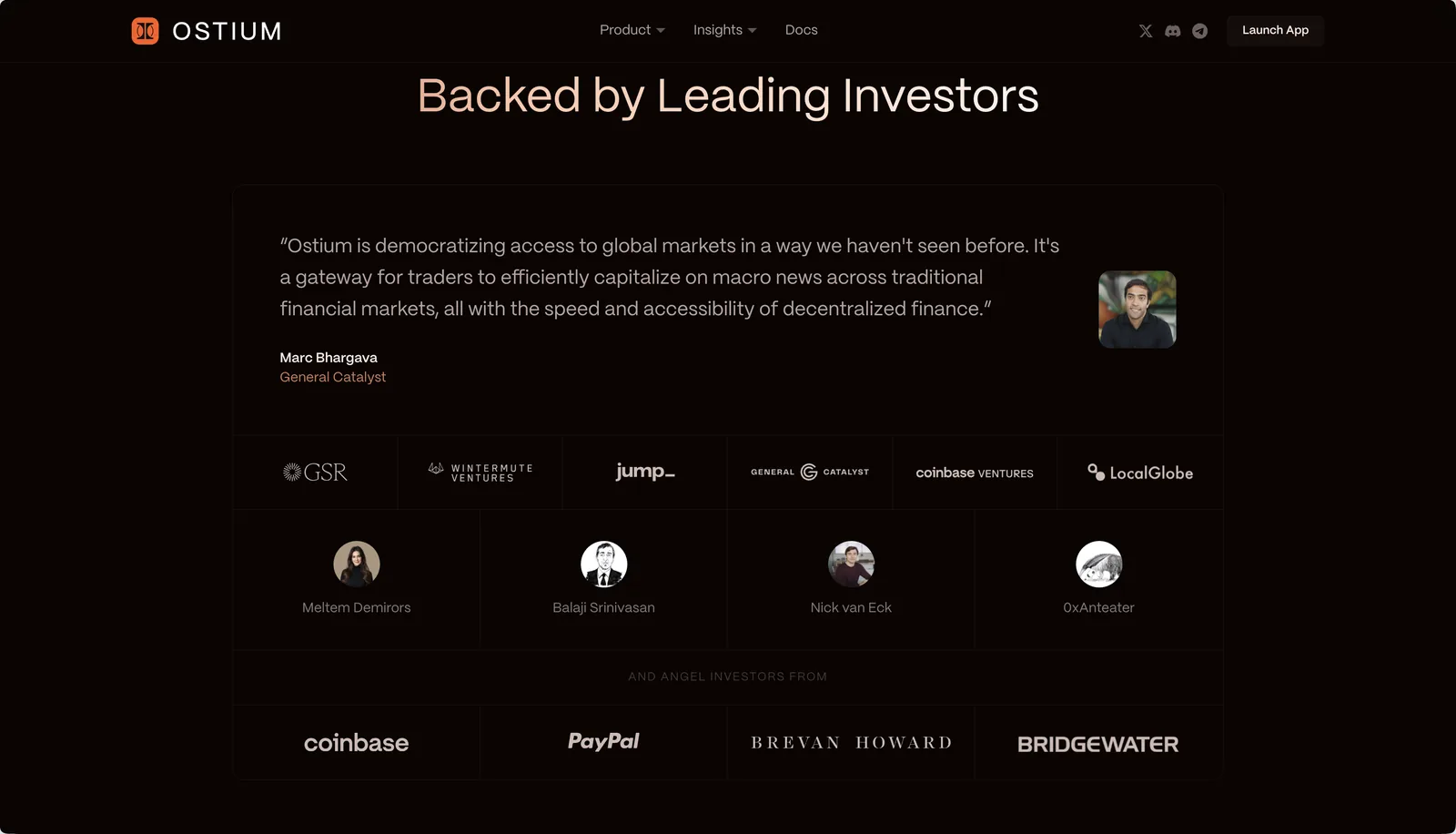
Scale check, per ostium.com in July 2026: $51B+ cumulative volume, $251M+ open interest, 26K+ active traders. Not Hyperliquid numbers, but for an RWA-focused venue this is the deepest game in town — and it's backed by General Catalyst, GSR, Jump, Wintermute Ventures, Coinbase Ventures and LocalGlobe, with angels from Coinbase, PayPal, Brevan Howard and Bridgewater.
📊 What can you trade on Ostium — markets, leverage, fees
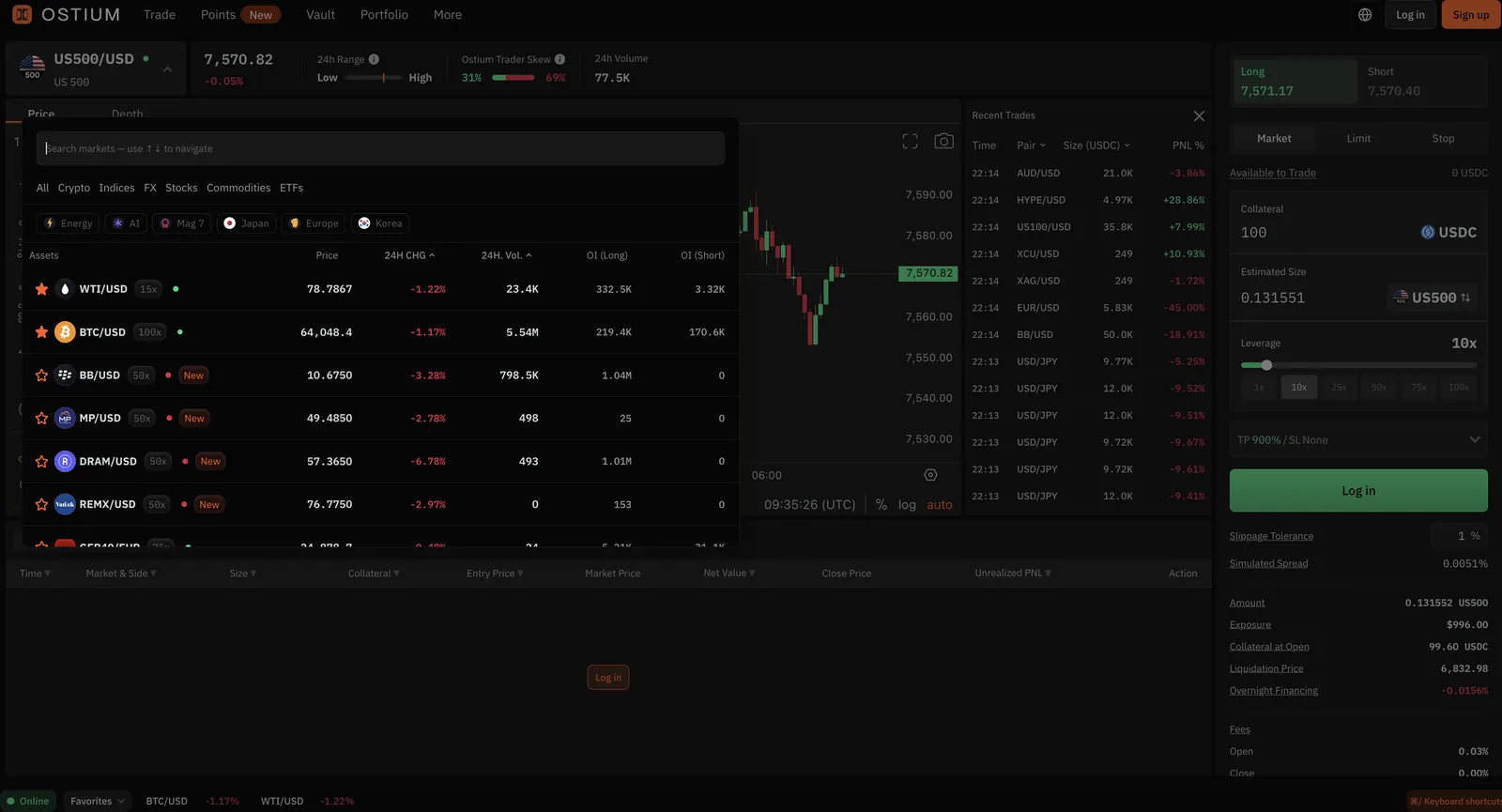
The market selector covers six categories plus thematic shelves (Energy, AI, Mag 7, Japan, Europe, Korea). Everything settles in USDC; what changes per asset is the leverage cap and the holding cost model:
| Asset class | Examples | Leverage seen in app* | Holding cost |
|---|---|---|---|
| Commodities | WTI oil, gold (XAU) | up to 15x on WTI | rollover fee |
| Indices | US 500, US 100, GER40 | up to 100x | rollover fee |
| FX | EUR/USD, USD/JPY | highest caps (up to 200x per docs) | rollover fee |
| Stocks | NVDA, TSLA + new listings | ~50x on new stock perps | rollover + day-trade rules |
| Crypto | BTC, ETH, HYPE | up to 100x | funding (longs vs shorts) |
*Leverage tags visible in the app on July 16, 2026; caps change per asset and time of day — the in-app selector is the source of truth.
Fees are refreshingly simple: an opening fee (0.03% shown on the US 500 ticket when I checked) plus a flat $0.50 oracle fee per opened trade — and no closing fee on manual, TP/SL or non-liquidated exits. Crypto pairs use classic funding between longs and shorts; real-world assets pay rollover, which mirrors the carry cost of the underlying market. The order ticket shows the exact net rate before you confirm — on my US 500 test ticket, overnight financing displayed as −0.0156%.
One RWA-specific habit to build: market hours. Crypto trades 24/7, but oil, indices and stocks follow their native sessions — positions can gap over a weekend close, and limit/stop orders queue until reopen.
💰 The OLP vault — passive USDC yield from the other side of the trades
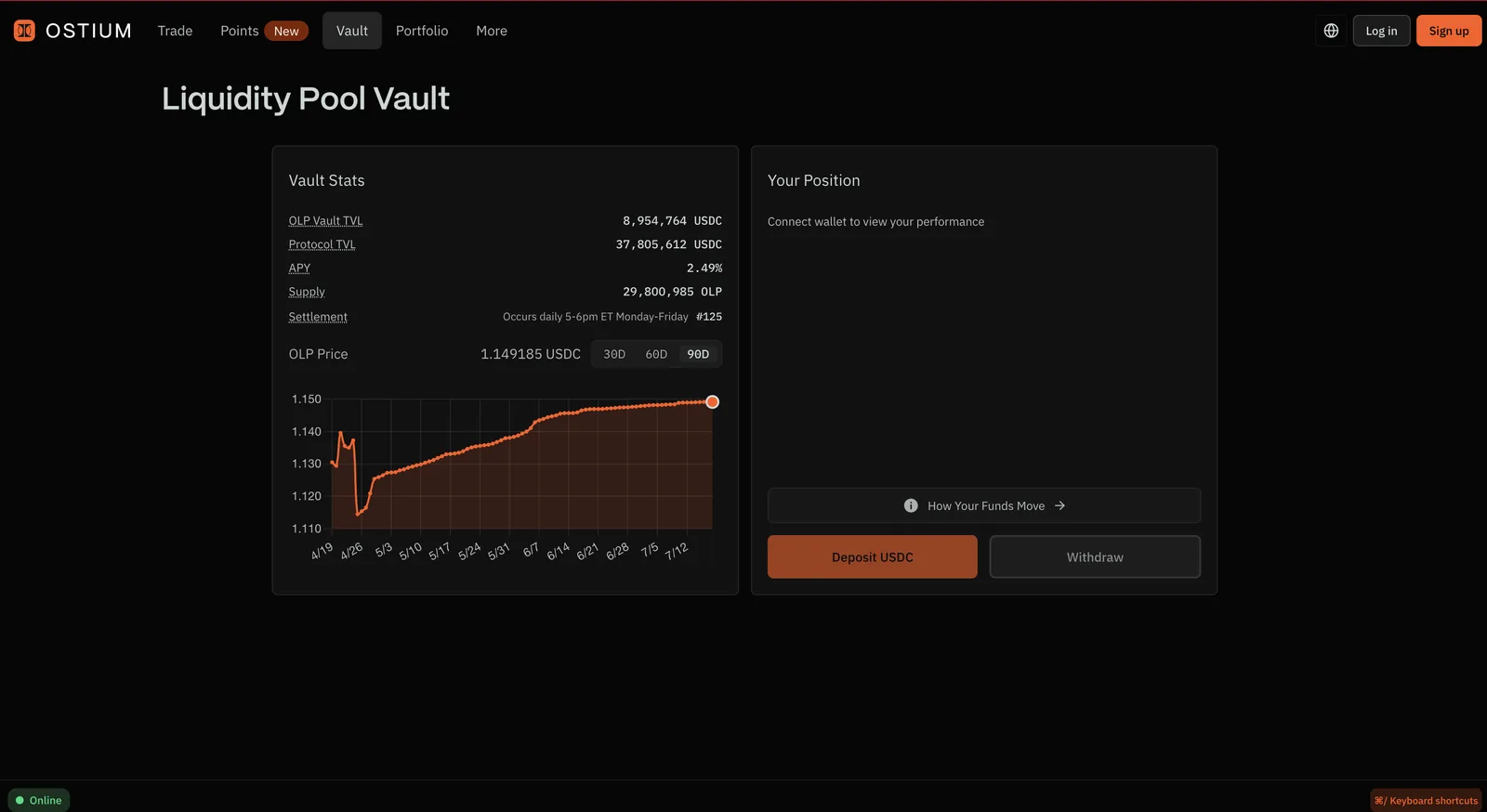
If you'd rather not trade, the other side of the venue is open too. The OLP vault takes USDC deposits and acts as the liquidity backbone for trades: it collects a share of opening fees, rollover fees and liquidation fees, settles daily (5–6pm ET, Monday–Friday).
The figures in the screenshot above (TVL ~8.95M USDC, APY 2.49%, share price 1.149185) are from 16 July 2026 and are kept here only as a record of what the vault looked like before the exploit. Do not read them as current.
I do not recommend depositing into OLP until compensation is finalised. This is the exact vault the attacker drained on 15 July 2026 — 23,752,746 USDC gone through a compromised oracle key. Ostium stated it would make affected liquidity providers whole from its own balance sheet together with partners; as of 16 September 2026 we found no official confirmation that this has been completed, nor the separate LP recovery plan promised in the 30 July post-mortem. Until it is, a deposit here is not "passive yield" — it is an unsecured claim on an ongoing recovery.
Separate the two decisions. Trading on Ostium means your collateral sits in your own positions on a venue that has resumed operating and hardened its oracle path. Depositing into OLP means voluntarily standing behind the venue with the same pool that was emptied seven weeks ago and has not publicly closed the loop with its depositors. Those are not the same risk, and the original version of this review treated them as one.
🎯 Points Season 2 — activity that might age well
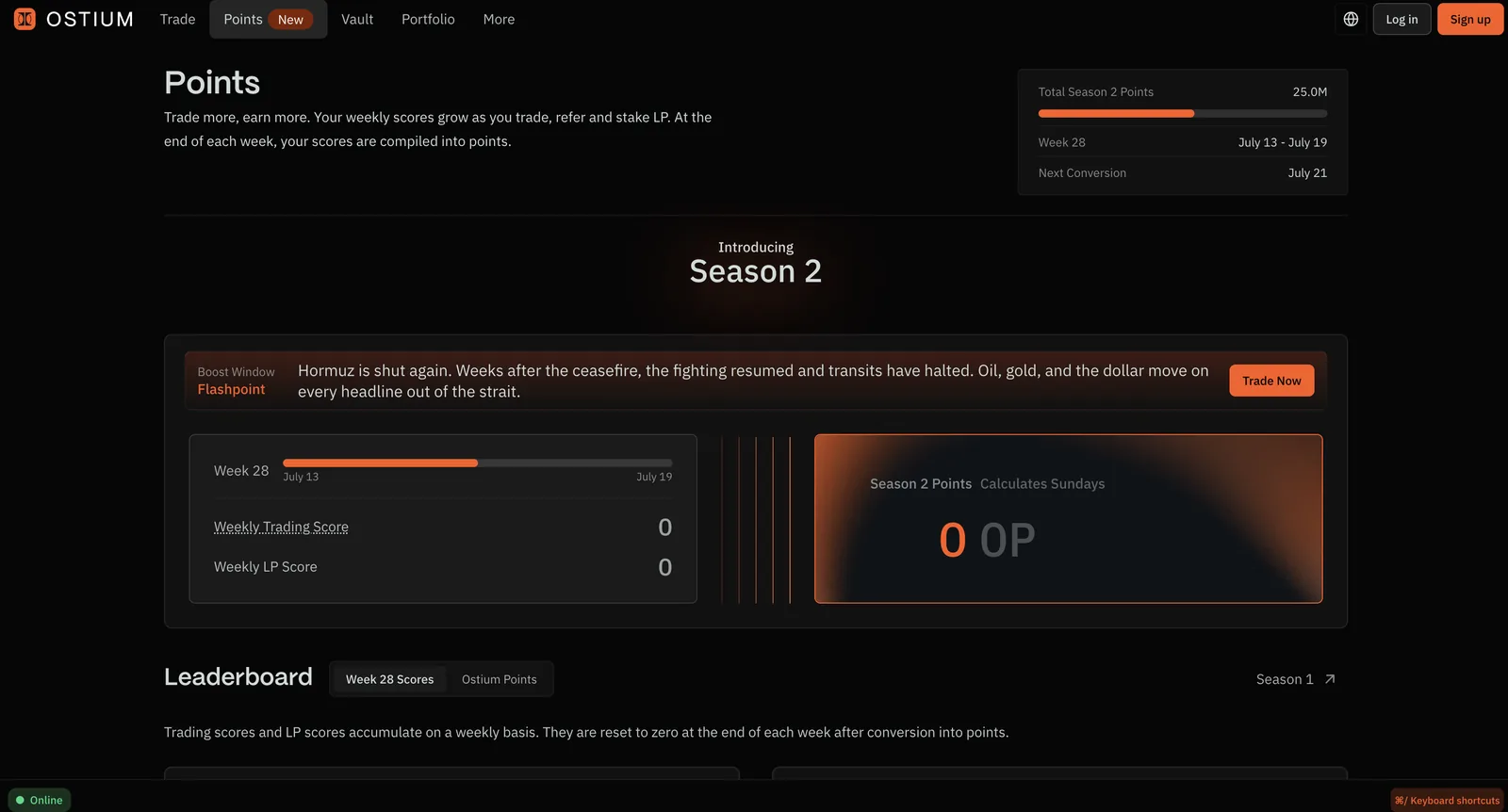
Ostium runs a Points program, now in Season 2: your weekly trading score and LP score convert into points every Sunday, with a public leaderboard. The twist I actually like: boost windows tied to macro events — during the July Hormuz disruption, oil, gold and dollar pairs earned boosted scores. It nudges you toward exactly what the venue is for: trading macro headlines on-chain.
There's no token and no airdrop promise — but points programs with seasons and leaderboards are how half of the current DeFi majors bootstrapped theirs. My take: if you're trading here anyway, points are free upside; trading for points is how people donate to the vault. Signing up through a referral code adds a boost to your points score (my current referral tier gives traders an 8% boost) — one of the few referral perks that costs the referred side nothing.
🚀 Getting started — two minutes, email or wallet
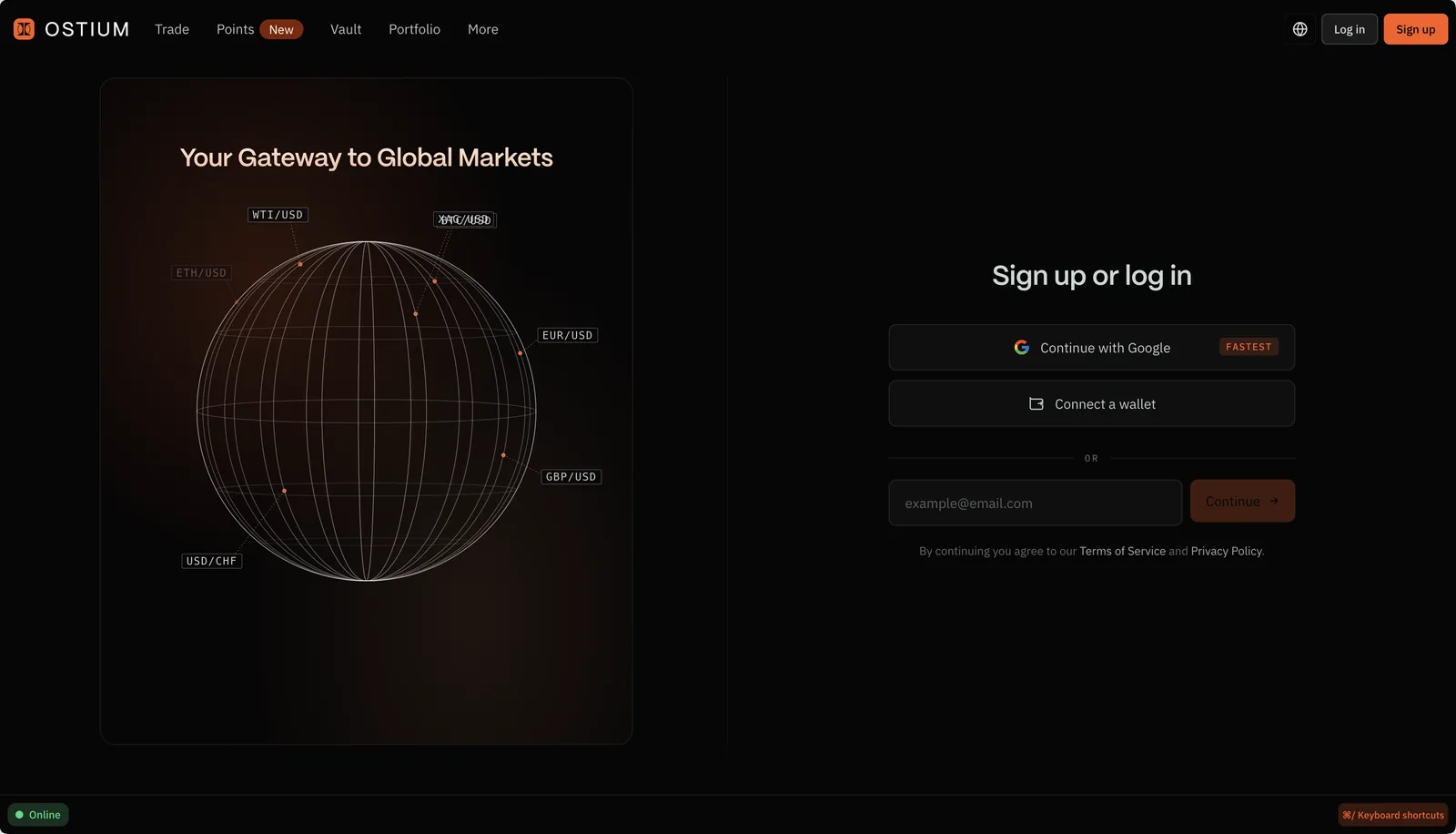
Onboarding is two clicks: Continue with Google (creates a gasless smart account — no seed phrase, no gas juggling) or connect a wallet (MetaMask, Coinbase Wallet, Rainbow, or any WalletConnect wallet). I tested the flow myself — from cold start to a funded account is genuinely a couple of minutes.
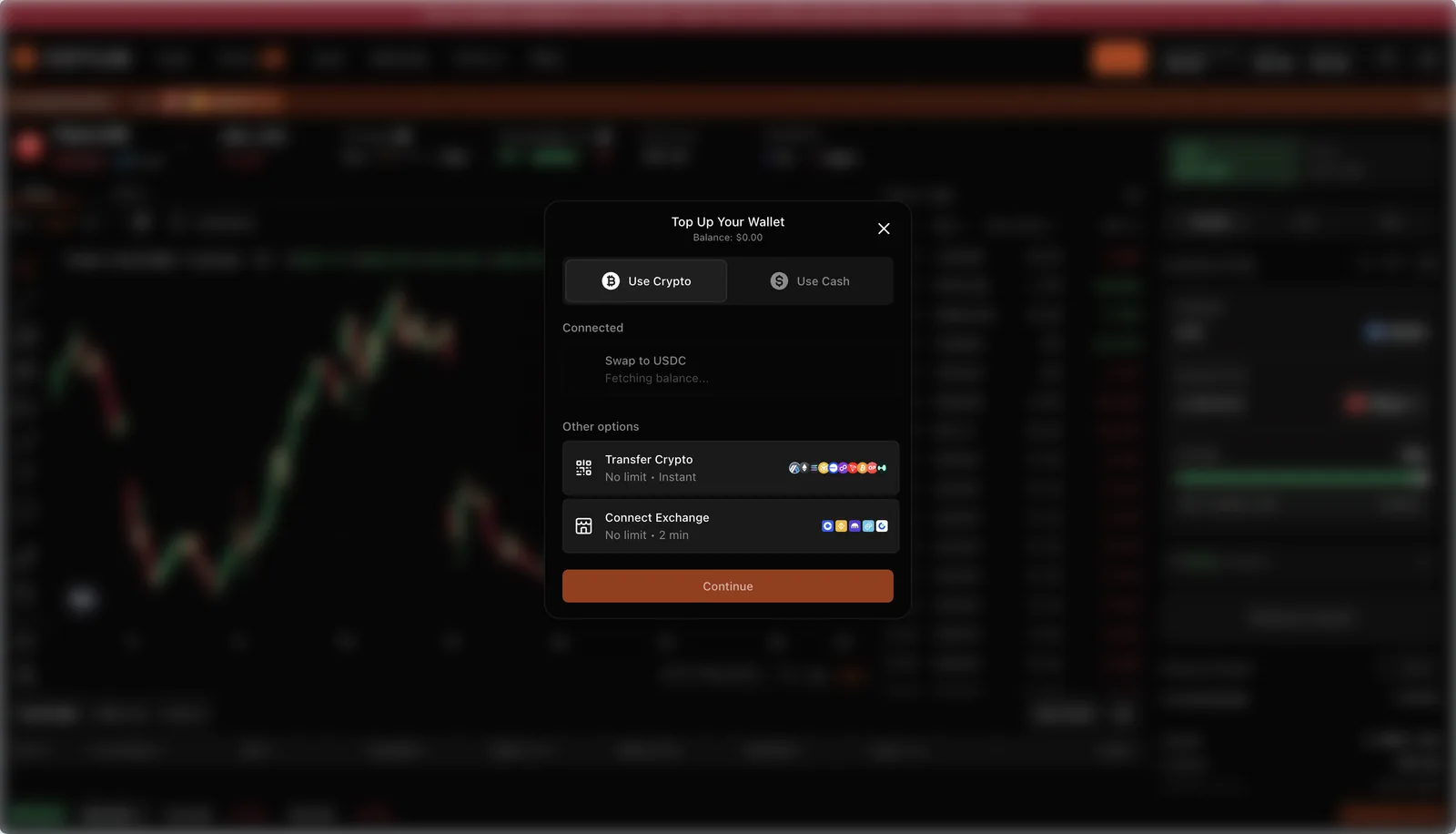
Funding is flexible for a DeFi venue: the built-in flow swaps or bridges whatever you have into USDC on Arbitrum, you can transfer crypto directly, connect an exchange account, or even use cash (card on-ramp). Withdrawals are the self-custody kind — instant, no broker approval window.
Quick start: 1) sign in with Google or wallet → 2) top up USDC (any of the four routes) → 3) pick a market, set size and leverage, add TP/SL → 4) the ticket shows the opening fee and net funding/rollover before you confirm.
🛢️ Open an Ostium account with my link →
📉 The honest part — synthetic perps cut both ways
I don't review these things without this section. Everything on Ostium is a synthetic perpetual: you trade price exposure against the protocol's liquidity pool, with oracles (Stork for RWAs, Chainlink for crypto) deciding the mark. You don't own the share or the barrel; there are no dividends and no voting rights. If the venue delists an instrument, your position closes — unlike a share at a broker.
Leverage amplifies both directions, and RWA market hours add a risk crypto traders forget: an oil or stock position can gap through your stop over a weekend or holiday close. Add standard DeFi caveats — smart-contract risk, oracle risk, and the fact that the vault model means the protocol itself is your counterparty. Geo-restrictions apply in some jurisdictions; check availability before funding.
Rule stays the rule: only trade what you're ready to lose, size positions so a gap doesn't liquidate you, and treat points and boosts as seasoning — never the meal.
🧭 Verdict — who Ostium is for
If you've wanted to short the S&P or ride oil headlines without opening a CFD brokerage account — this is the cleanest on-chain way I've tested in 2026: familiar terminal, one USDC balance for macro and crypto, opening-fee-only pricing, and instant self-custody withdrawals. The OLP vault adds a passive lane, and Points Season 2 pays you for activity you'd do anyway.
Two caveats that outrank everything above. First, the 15 July 2026 exploit is part of this venue's record: a compromised oracle key drained 23,752,746 USDC from the OLP vault, trading was halted and resumed on 23 July. A venue that has been exploited and reopened is not automatically a bad venue — but you deserve to weigh it, and this review failed to give you that the first time. Second, trading here and depositing into OLP are different decisions now: I would do the first with risk capital and would not do the second until compensation for affected depositors is confirmed complete (as of 16 September 2026, it is not).
It is not a place for money you can't afford to lose — synthetic, leveraged, oracle-priced. For the bigger picture on how real-world assets are moving on-chain, read what is RWA tokenization, and for the CEX take on the same trend — my Bybit TradFi review.
Register via my link
Sign up on Ostium with my referral link
Frequently asked
What is Ostium in simple terms?+
Ostium is a decentralized trading venue on Arbitrum where you trade perpetual contracts on real-world assets — oil, gold, forex pairs, indices like the S&P 500, single stocks — plus crypto, straight from a crypto wallet or an email-based account. You post USDC as collateral and trade price exposure. You never take delivery of the barrel of oil — and that's the point.
Does Ostium have real stocks or synthetic assets?+
Synthetic. Everything on Ostium is a perpetual contract that tracks the price via oracles (Stork for real-world assets, Chainlink for crypto). You get the price movement, long or short, but you don't own the share and have no voting rights. Unlike a broker, there's no account approval — but also no underlying asset held in your name.
What are Ostium's fees?+
You pay an opening fee when you enter (on the US 500 the app showed 0.03% at the time of writing) plus a flat $0.50 oracle fee per opened trade, and there is no closing fee. Holding costs: crypto pairs pay/receive funding between longs and shorts; real-world assets pay a rollover fee that reflects the underlying market's carry costs. The exact net rate is shown on every market before you confirm.
What leverage does Ostium offer?+
Up to 200x on supported markets, with caps that differ per asset — in the app I saw 100x available on BTC and the US 500, lower caps like 15x on WTI oil, and around 50x on newly listed stock perps. Stocks follow day-trading rules: higher intraday leverage with auto-close before the closing bell, lower overnight.
What is the OLP vault and what does it earn?+
OLP is Ostium's liquidity pool vault: you deposit USDC, and the pool acts as the counterparty backing trades. It earns a share of opening fees, rollover fees and liquidation fees. At the time of writing the app showed 2.49% APY, about 8.95M USDC in the vault, and an OLP share price of 1.149 — roughly +15% cumulative since launch. Yield is variable and the vault can bear losses when traders win.
What are Ostium Points and Season 2?+
Points are Ostium's activity program — you earn weekly trading and LP scores that convert into points every Sunday, with a public leaderboard. Season 2 is live (week 28 ran July 13–19, 2026) and features boost windows tied to macro events — for example a boosted window on oil, gold and dollar pairs during the July Hormuz disruption. Points programs like this are commonly read as a possible airdrop signal, but Ostium promises nothing — treat it as a bonus, not a reason to trade.
Is Ostium safe to use?+
Oracle risk here is not hypothetical — it happened. On 15 July 2026 a compromised oracle key let an attacker push fake prices and drain 23,752,746 USDC from the OLP vault. Ostium halted trading and reopened on 23 July 2026 after hardening that path, and the venue operates now. Compensation for affected OLP depositors was promised but, as of 16 September 2026, we found no official confirmation it is complete. Beyond that: it is self-custody, so no broker holds your money, but smart contracts and oracles can fail, the protocol is your counterparty via its vault, leverage cuts both ways, and RWA positions can gap over weekend closures. Only trade risk capital, and see the OLP section before depositing into the vault.
Want a review like this for your project?
YouTube review + Telegram + an evergreen blog article — EN · ES · RU-CIS markets. Real audience, verifiable results.