· 1814 words · 9 min
📈 Ondo Tokenized Stocks Review 2026 — Trade Tesla & Nvidia On-Chain With Up to 20× Leverage
Hands-on Ondo review 2026 — leveraged trading of tokenized US stocks (up to 20×) for non-US users. 260+ tokenized stocks & ETFs across Solana, Ethereum and BNB Chain, $1B+ TVL, $18B+ volume. Honest take on how it works, why it's outside the US, and the real risks of 20× leverage.
Honest review. Some links are affiliate links: same price for you, a small commission for the project.
⚡ Quick answer — is Ondo worth a look?
Here is the short version, before the detail: tokenization of real-world assets is one of the most important shifts in crypto right now, and Ondo is currently the platform leading the tokenized-stock corner of it. You can now hold a token that represents a real Tesla or Nvidia share, settle it in crypto, and — if you're outside the US — trade it with leverage, 24/7, without ever opening a brokerage account.
So is it worth understanding? Absolutely. Is it worth maxing out 20× leverage on? That's a completely different question, and the honest answer runs through the rest of this review.
🎁 Trade leveraged positions on Bybit — up to $30,000 in welcome rewards (my link)
⚠️ Disclosure: this is an independent review — nobody paid me for it. The article links to Bybit, the exchange I personally trade leveraged positions on; that's a referral link (I earn a commission and your fees stay the same). Links to Ondo are not affiliate links. I researched the product before publishing.
🏛️ What Ondo actually launched
Ondo already ran Global Markets, a platform that mints tokenized versions of US stocks and ETFs. The new piece is leverage: non-US users can now open leveraged positions — up to 20× — on those tokenized stocks, directly from a crypto wallet.
Strip away the jargon and it's simple: the stock market got a 24/7, crypto-native front end. No broker to onboard with, no paperwork, no waiting for the opening bell, and settlement happens on-chain in minutes rather than on the old T+1 cycle. That's genuinely new — and, as always, the convenience comes with trade-offs worth naming out loud.
🧩 What a tokenized stock actually is
A tokenized stock is a blockchain token backed 1:1 by a real share held with a US-registered broker-dealer custodian. One token equals one share, and it tracks the full total return, dividends included. The custodian buys and holds the underlying share; the token is the on-chain claim against it, and it can be minted or redeemed around the clock — including on weekends.
So this is not a "Tesla meme coin" that merely points at a price. It's a fully collateralised asset in a new wrapper. The honest nuance: you hold a tokenized claim, not a share registered in your own name, and you generally don't get shareholder voting rights. For a trader that's irrelevant; for someone who wants to be a registered Tesla shareholder, it matters.
⚙️ How it works, step by step
It feels close to a normal trading app:
- Connect a crypto wallet to the Ondo Perps interface — no account application, no KYC paperwork queue like a broker.
- Pick the token of the stock or ETF you want — Tesla, Nvidia, a sector ETF, and so on.
- Post your tokenized shares (or stablecoins) as collateral — that buying power is what backs the position.
- Choose your leverage and direction, then open the position.
- Close anytime — at night, on the weekend, long after the traditional market has shut.
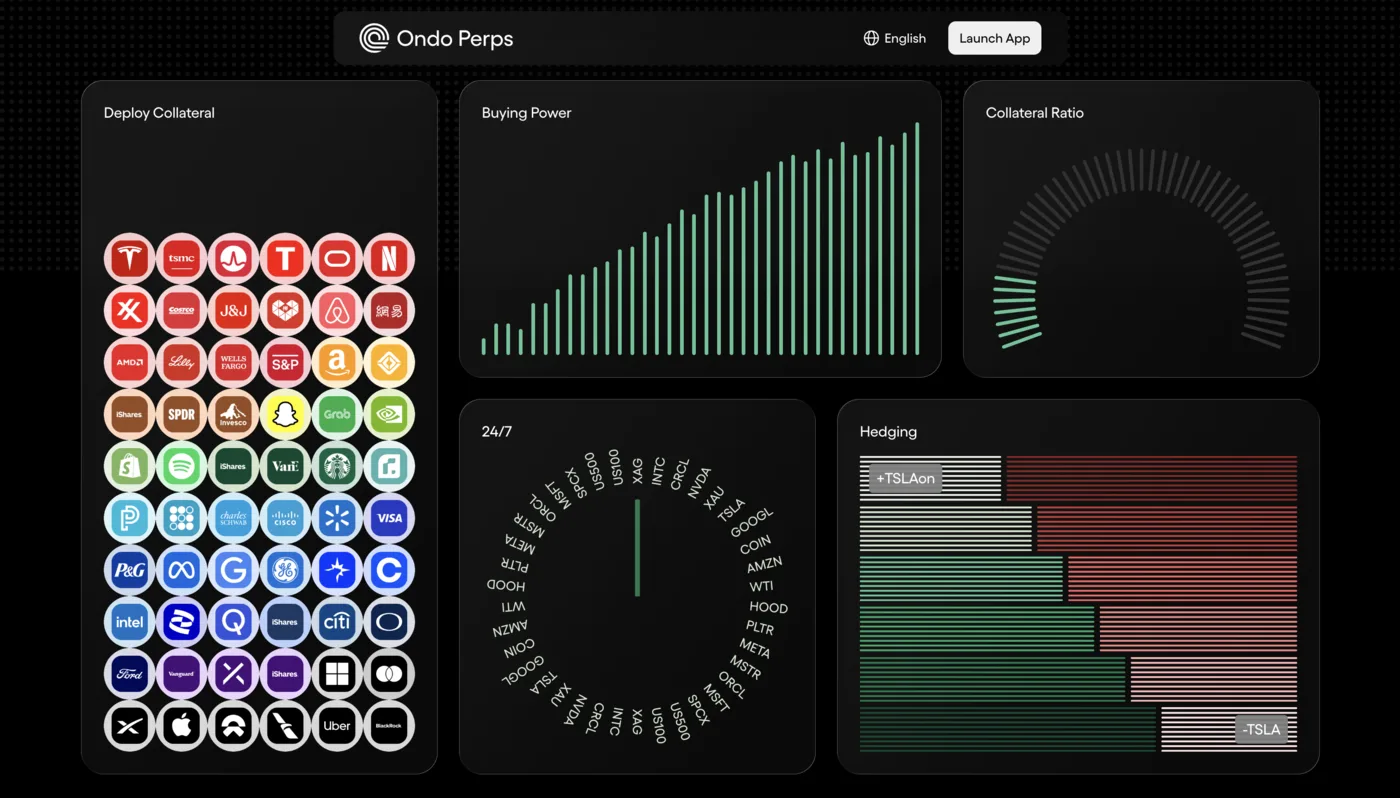
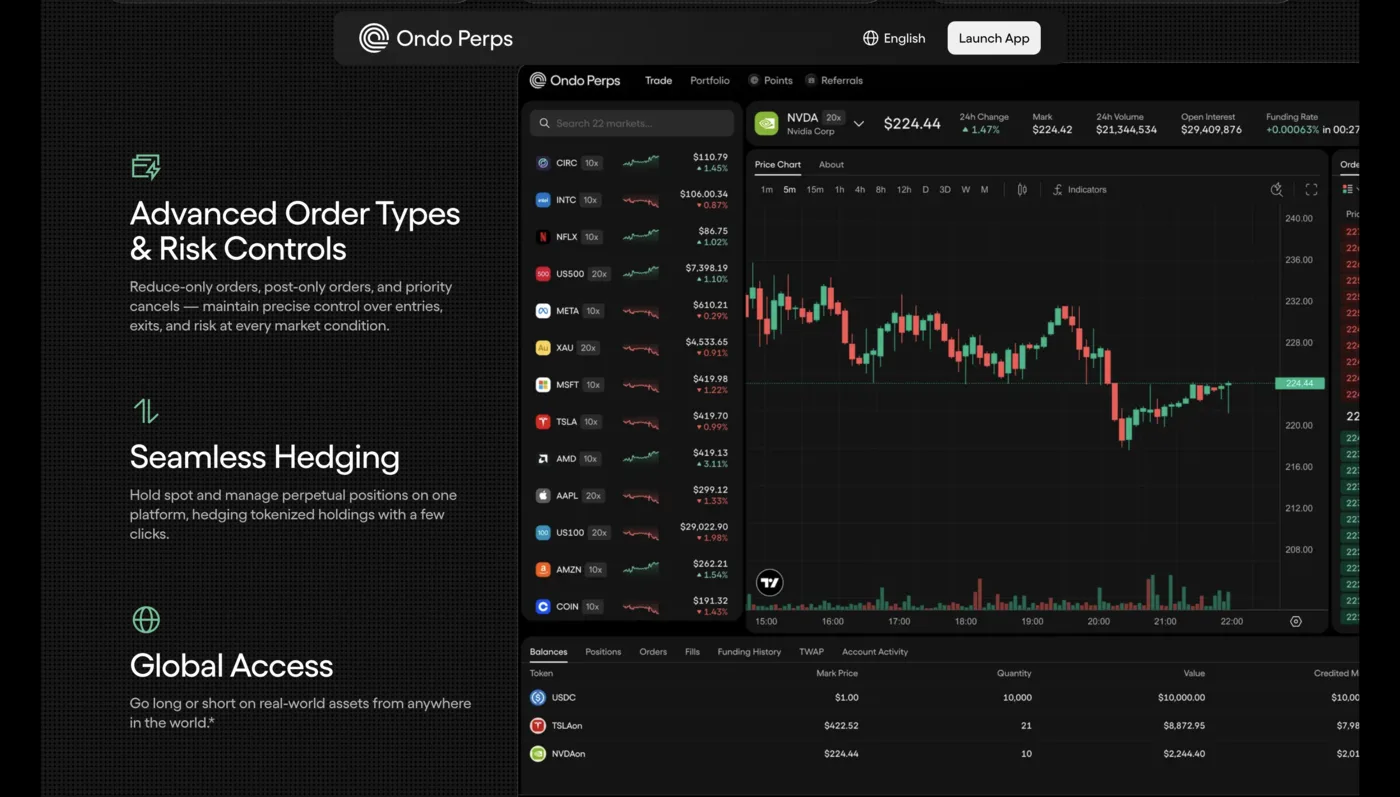
The interface itself is closer to a pro derivatives terminal than a beginner stock app: live charts, advanced order types, hedging. Powerful — and a reminder that this is a trading product, not a "set and forget" savings account.
📊 The numbers — this is not a toy
Scale is the part that separates a real product from a demo:
- 260+ tokenized stocks and ETFs, live across Solana, Ethereum and BNB Chain.
- First platform of its kind to cross $1B in total value locked — and it did it in under eight months.
- $18B+ in cumulative volume to date.
- The broader Ondo ecosystem reports ~$3.63B TVL, 12 supported chains and 165 integrated projects.
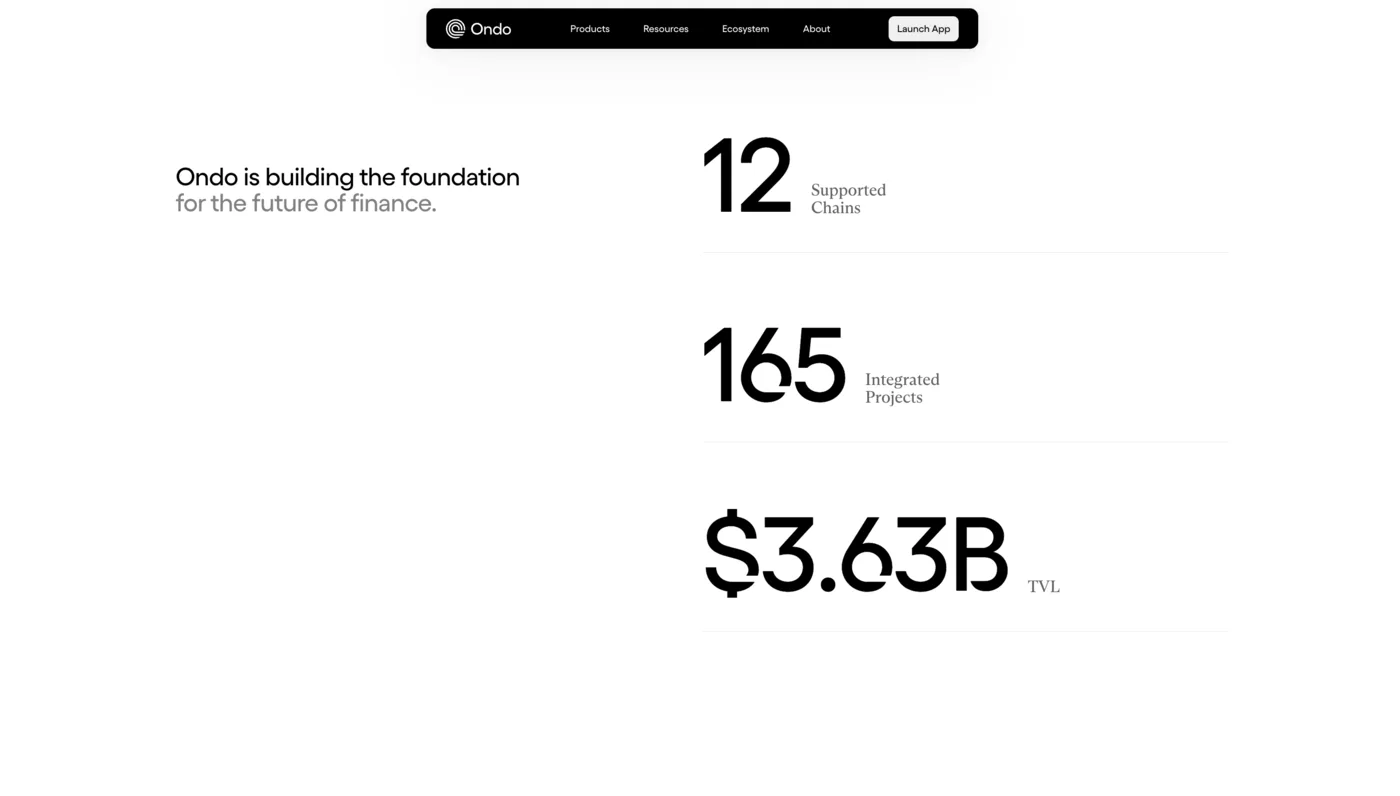
Those are not numbers you fake into existence. Distribution is widening too — wallets and apps are plugging tokenized stocks in as a native feature rather than a novelty.
⚖️ Ondo vs the alternatives
Ondo isn't the only way to get equity exposure on-chain. Here's the honest landscape:
| Platform | Who it's for | Edge | Watch-outs |
|---|---|---|---|
| Ondo Global Markets | Non-US users wanting breadth + leverage | 260+ assets, multi-chain, up to 20× leverage, 24/7 mint/redeem | Leverage + oracle + custodian risk; non-US only |
| xStocks (Backed) | Non-US retail, spot traders | Highest tokenized-equity volume so far, fast/cheap on Solana | Mostly spot; issuer/SPV structure to understand |
| Dinari (dShares) | US accredited + non-US retail | Most US-native — SEC-registered broker-dealer | Access gated; fewer assets |
| Robinhood (EU) | EU retail | Vertically integrated app, familiar UX | EU-only, walled garden |
| Traditional broker | Everyone, long-term investors | Regulatory protection, voting rights, no oracle/custodian layer | Not 24/7, not crypto-native, regional access limits |
The takeaway: Ondo wins on breadth and leverage; a regular broker still wins on protection and simplicity. They solve different problems.
🌊 Part of a much bigger wave
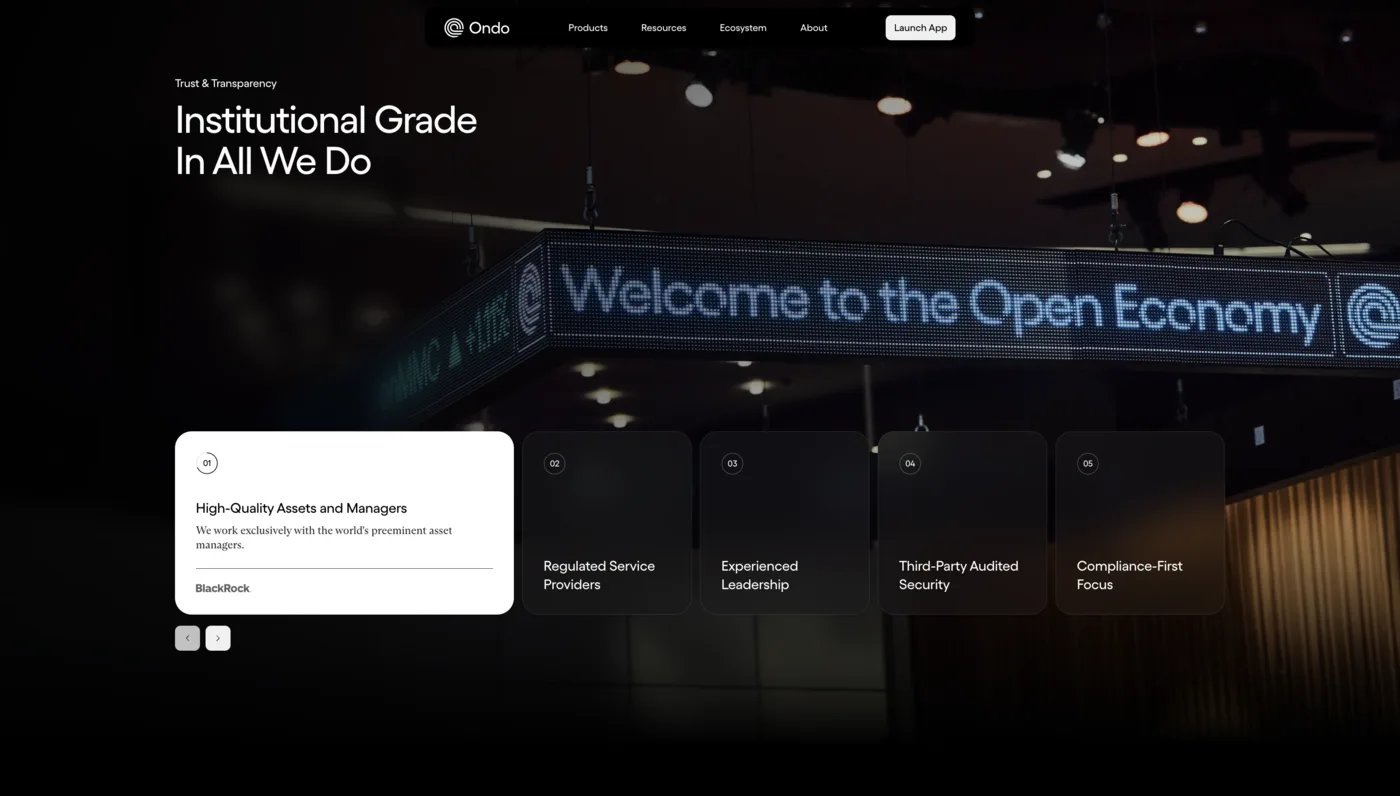
This isn't one startup's experiment. Citi projects the tokenized-securities market will grow from roughly $17B today to $5.5 trillion by 2030. More telling than the forecast is who is building the rails — not crypto startups, but Wall Street's own infrastructure: the largest securities depository, Nasdaq, and the owner of the New York Stock Exchange. When institutions of that calibre move on-chain, it stops being an experiment.
For the bird's-eye view of where this whole category is heading, I broke it down in my RWA tokenization explainer.
🌍 Why "outside the US"?
Inside the States there's still regulatory fog around leveraged tokenized securities, so for now the product is for non-US users. It's not a loophole and not a grey zone — it's the current reality of the market while US rules catch up. I'd rather be straight about that than dress it up as "exclusive early access."
⚠️ The real risks — read this part twice
The upside is obvious: 24/7 access to US equities, in crypto, with leverage. The catches are just as real.
- 20× is no joke. At that leverage, a 5% move against you wipes the position. A regular brokerage would never hand a retail trader that much. Rule one: don't confuse "I have access" with "I have to max it out."
- Oracle dependency. Prices are held by oracles — external data feeds. If one breaks or is manipulated during thin liquidity, it can trigger liquidations that have nothing to do with the real stock price.
- Custodian / counterparty risk. Your token is only as safe as the broker-dealer holding the real shares. The risk didn't disappear with tokenization — it moved to the custodian. Proof-of-reserves and audits matter here.
- Weekend and after-hours gaps. The token trades 24/7, but the underlying market doesn't. A position held over the weekend can face a hard Monday-open gap — brutal at high leverage.
- Intermediary / allocation dependency. 2026 already gave a cautionary example: when several exchanges promised customers IPO-price access to a hot listing through tokenized shares and couldn't deliver the promised allocation, the promises collapsed. A token is only as good as the chain of intermediaries behind it.
- Regulatory and regional uncertainty. Availability can change as rules evolve.
None of this is a reason to panic. It's a reason to understand what the structure stands on before you fund it.
✅ Pros & ❌ cons
Pros
- 24/7 access to US stocks and ETFs without a US brokerage account
- Real 1:1 backing with dividends passed through, not a synthetic price toy
- Breadth (260+ assets) and multi-chain availability
- Backed by serious, regulated Wall Street infrastructure — the trend is durable
Cons
- Up to 20× leverage is a fast path to liquidation for the inexperienced
- Oracle, custodian and intermediary dependencies you must trust
- Non-US only for the leveraged product
- No shareholder voting rights; you hold a tokenized claim, not a registered share
👤 Who it's for (and who should skip it)
Consider it if you're a non-US trader who already understands leverage and risk management, wants 24/7 access to US names in crypto, and treats it as a trading tool with strict position sizing.
Skip it if you're a passive long-term investor (just buy the real share or an ETF), if you can't stomach the oracle/custodian trust assumptions, or if you'd be tempted to open at max leverage. Access is not a strategy.
💹 If you're going to trade leverage — the platform matters
Trading with leverage is always about risk, and the venue you use matters a lot — liquidity, tooling and reliability decide whether you survive a volatile candle. I personally trade leveraged positions on Bybit: solid tools, deep liquidity, and up to $30,000 in welcome rewards when you sign up.
👉 Trade on Bybit (my link) · New to it? Here's how to register on Bybit step by step.
🎯 My verdict
Tokenization of stocks really does look like the bridge between traditional finance and crypto that's being built right now — and Ondo holds most of that market for the moment. But a "bridge" and a "20× casino" are two very different things.
The tokenization itself is infrastructure — it's here to stay, and it's worth paying attention to. Max-leverage trading on top of it is a tool for people who understand the risk and can control it. If you try it, start small — and definitely not at max leverage.
What I'm watching from here: whether Ondo keeps its share once competitors scale, how liquidity behaves when regulated venues ramp volume, and how the custody and oracle layers hold up under real stress.
⚠️ Risk warning — leverage
This is not financial advice, and leveraged trading is not passive income. Up to 20× means a single bad move can wipe your balance in minutes. Before trading leverage seriously:
- Size positions properly — never risk more than 1–2% of total capital per trade
- Use a stop loss on every position, no exceptions
- Never trade with money you can't afford to lose
- Test with small size first, scale only after a positive track record
Watch the full video review on YouTube — the same breakdown with the Ondo interface walked through on screen.
Register via my link
Trade with leverage on Bybit — up to $30,000 welcome rewards (my link)
Frequently asked
What is Ondo and what did it just launch?+
Ondo Finance is a real-world-asset (RWA) platform that tokenizes US stocks and ETFs and brings them on-chain. Its newest product lets non-US users trade tokenized US stocks with leverage — up to 20× — directly from a crypto wallet, 24/7, with no broker and no paperwork. In plain terms: the stock market moved onto the blockchain, and you can now hold and trade a token that represents a real Tesla or Nvidia share.
What is a tokenized stock — is it really backed by a real share?+
Yes. A tokenized stock is a token on the blockchain backed 1:1 by a real share held with a US-registered broker-dealer custodian. One token equals one share, and it tracks the full total return — dividends included. So it is not a 'Tesla meme coin': it's a fully backed asset, just wrapped in a new, on-chain form that can settle around the clock.
Do I own the actual share and get the dividends?+
You own a token that is collateralised 1:1 by a real share held by the custodian, and the token tracks total return including dividends — so the economic exposure (price + dividends) is passed through to you. What you typically do not get is direct shareholder voting rights or a share registered in your own name at the transfer agent; legally you hold a tokenized claim, not the registered share. For most traders that distinction doesn't matter, but it's the honest nuance.
Is Ondo available in the US? Why is it 'outside the US' only?+
At the time of writing, the leveraged tokenized-stock product is for non-US users. Inside the United States there is still regulatory fog around leveraged tokenized securities, so the product is rolled out to non-US users for now. It is not a loophole or a grey zone — it's simply the current reality of the market while US rules catch up.
How much leverage does Ondo offer, and how risky is 20×?+
Up to 20×. That is a lot: at 20× leverage, a 5% move against your position is enough to wipe it out entirely. A traditional brokerage would never hand a retail trader that much. Leverage is a tool, not a target — 'I have access to 20×' is not the same as 'I should use 20×'. If you trade it at all, start with small size and low leverage, and use a stop.
How is this different from xStocks, Dinari or just buying the real stock?+
xStocks (issued by Backed) is the highest-volume tokenized-equity product today, optimised for fast, cheap spot trading on Solana. Dinari (dShares) is the most US-native route — an SEC-registered broker-dealer serving US accredited and non-US retail. Ondo's edge is breadth (260+ tokenized stocks and ETFs across several chains) plus built-in leverage and 24/7 mint and redemption. A traditional broker still wins on regulatory protection, voting rights and zero oracle/custodian dependency — it just isn't 24/7 or crypto-native.
Which blockchains does Ondo support and how many stocks are tokenized?+
Ondo has more than 260 tokenized stocks and ETFs, live across Solana, Ethereum and BNB Chain. In May it became the first platform of its kind to cross $1 billion in total value locked — in under eight months — and cumulative volume has passed $18 billion. The official site lists 12 supported chains, 165 integrated projects and around $3.63B TVL across the broader Ondo ecosystem.
What are the real risks of trading tokenized stocks on Ondo?+
Five to weigh. 1) Leverage — up to 20× can liquidate a position on a small adverse move. 2) Oracle dependency — the price is held by external data feeds; if one breaks, it hits the whole collateral system. 3) Custodian/counterparty risk — your token is only as safe as the broker-dealer holding the real shares. 4) Weekend and after-hours price gaps — the token trades 24/7 but the underlying market doesn't, so Monday opens can gap hard against a leveraged position. 5) Regulatory and regional uncertainty — availability can shift as rules evolve. Tokenization itself looks like durable infrastructure; max-leverage trading on top of it is the part that demands real risk management.
Want a review like this for your project?
YouTube review + Telegram + an evergreen blog article — EN · ES · RU-CIS markets. Real audience, verifiable results.