· 1305 words · 7 min
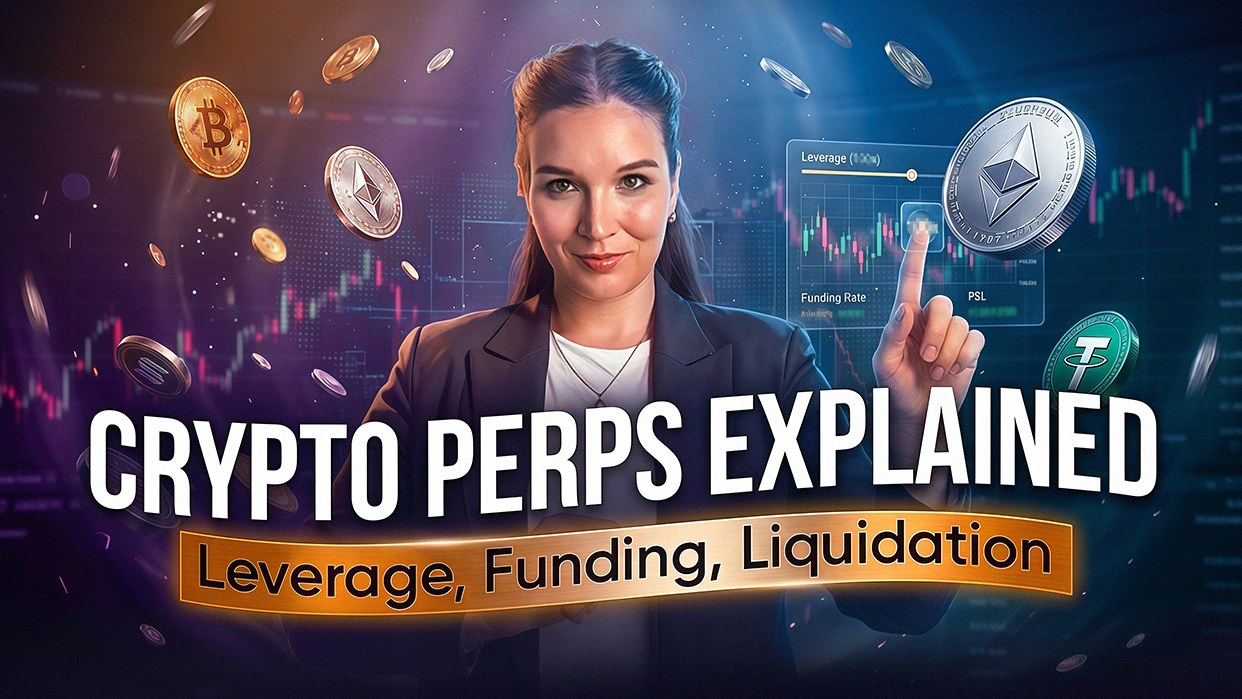
⚙️ Crypto Perps Explained (2026) — Funding, Leverage and the Liquidation Line
How perpetual futures actually work - direction not ownership, no expiry, the funding rate nobody explains, and the liquidation line that ends most positions.
Honest review. Some links are affiliate links: same price for you, a small commission for the project.
Updated: 03-08-2026 · Explainer · ~8 min
ⓘ Kalshi is a partner of this channel and the Kalshi links below are affiliate links — same price for you, a small commission for me. It does not change what is written here, including the parts about risk. Nothing on this page is financial advice.
What is a crypto perpetual, in plain terms?
A perpetual is a contract on price direction that never expires. You do not own the asset — you hold a position that gains or loses as the price moves. There is no settlement date, so instead of expiry a small recurring payment called the funding rate keeps the contract tethered to the spot price. Leverage decides how far the market can move before you are liquidated.
📈 Trading perps onshore in the US: Kalshi — CFTC-regulated perpetuals · new users who sign up with my link and trade $50 get a bonus
Perp vs futures vs spot — what actually differs
| Spot | Traditional futures | Perpetual | |
|---|---|---|---|
| Do you own the asset | ✅ yes | ❌ no | ❌ no |
| Expiry date | none | fixed settlement date | none |
| What keeps price near spot | it is spot | convergence at expiry | funding rate |
| Forced exit | none | settlement | liquidation |
| Leverage | usually none | yes | yes, often the headline feature |
| Main hidden cost | spread | roll cost at expiry | funding paid while you hold |
The row that matters most is the last one. Spot has no clock and no rent. A perp has no clock and rent, and the rent is charged the entire time the position is open.
The four moving parts
1. You trade direction, not the asset
When you buy Bitcoin you own Bitcoin. When you open a perpetual you own nothing — you hold a claim on which way the price goes. Long if you think up, short if you think down. That single distinction explains why perps can be opened in both directions with the same ease, and why "I'm up 40%" on a perp is not the same sentence as "I'm up 40%" on spot.
2. It never expires
A traditional futures contract has a settlement date. The clock runs out, the position closes, you take the result. A perpetual has no clock. You stay in until you close it — or until the market closes it for you. That second half is the one that ends most perp stories, and it has a name: liquidation.
3. Leverage is speed, not power
Leverage lets you control a position larger than the cash you put up. Put down $100 at ten-times leverage and you control $1,000. It amplifies a correct call and amplifies a wrong one by exactly the same factor.
The clearest way to see it: two traders, same coin, same direction. One uses 2x, the other 50x. The market dips 2%. The first barely notices. The second is already out. Same idea, same day, different amount of respect for the tool.
Ten-times leverage does not make you ten times smarter. It makes you ten times faster, in whichever direction you were already heading.
4. The funding rate — the part nobody explains
Here is the question that should bother anyone trading these: if a perp never expires, what keeps its price glued to the real Bitcoin price? Nothing forces them to match.
The answer is the funding rate. Every few hours one side pays the other a small fee. When too many traders are long, longs pay shorts. When too many are short, shorts pay longs. It is a gentle tax that pulls the contract back toward spot and keeps it honest.
Two consequences most guides skip:
- Funding is charged whether you are winning or losing. It is rent on the position, not a fee on profit. Hold a position for weeks and it compounds quietly.
- Funding can pay you. If you are on the light side of the book, you receive it. That also makes it a sentiment gauge: if holding your position is expensive, you are standing with the crowd.
What liquidation actually is
When price moves against you far enough, the exchange closes your position at a loss to protect the money you borrowed. Not a warning, not a margin call you can answer — the position is simply gone.
The important mechanic: the higher your leverage, the closer the liquidation line sits to the current price. Low leverage buys the market room to breathe. High leverage means one bad candle. This is the single variable that decides whether a trader lasts a year, and it is the one most people never look up before opening a position.
A practical habit that costs nothing: before you confirm a trade, say your liquidation price out loud. If you cannot, you are not ready to place it.
Where you can trade perps if you are in the US
For years the answer was uncomfortable. US traders who wanted perpetuals were pushed onto offshore platforms and quietly hoped nothing went wrong — no domestic regulator, no recourse, and in 2022 a lot of people found out what that means in practice.
That has changed. Kalshi is the first CFTC-regulated US exchange to offer perpetuals — onshore, under federal oversight, with the legal protections a regulated venue carries.
What I actually like about it, having gone through the interface for the video: it does not hide the risk. Position health is displayed live — healthy, at risk, high risk — right on the screen. The liquidation line we just spent a section on stops being a surprise and becomes a number you can watch. That is the difference between a venue that wants you to survive and an app that does not care either way.
One honest caveat on leverage: caps on a regulated venue are lower than what offshore platforms advertise. Limits move — check the current numbers in the app before you size a position.
📈 Open a Kalshi account with my link — new users who sign up and trade $50 get a bonus. Perpetual futures carry high risk and you can lose your entire deposit.
Kalshi's other side is event contracts — yes-or-no markets on Fed decisions and inflation prints, where the price is the probability. That instrument is simpler than a perp and worth understanding on its own: Prediction Markets Explained.
If your concern is custody rather than jurisdiction, there is a second route: wallet-native perps, where collateral settles from your own wallet instead of an exchange account and every order can be signed on a hardware device. I opened a real position that way in the OneKey Perps review.
The honest summary
A perp is not a money button. It is a precision instrument: excellent if you respect it, brutal if you do not. Anyone selling you a guaranteed outcome with leverage attached is selling you the fast version of losing.
If you take four things from this page: you trade direction rather than the asset, it never expires so funding quietly keeps it in line, leverage cuts in both directions, and liquidation is always watching. Learn it on a regulated venue, keep leverage humble, watch the risk indicator rather than only the profit and loss, and trade only what you are ready to lose.
Related reading: Kalshi Perpetuals Review 2026 — the hands-on walkthrough of the platform itself.
Written by Maria Klimenok · CRYPTO LADY. Perpetual futures carry a high risk of loss, including the full loss of your deposit. This article is educational and is not financial advice.
Running a campaign and want this kind of breakdown for your product? Formats and pricing · Telegram
Register via my link
Trade perps on Kalshi — CFTC-regulated, onshore in the US
Frequently asked
Do perpetual futures really never expire?+
Correct. Unlike a traditional futures contract there is no settlement date. The position stays open until you close it or until it is liquidated. The funding rate replaces expiry as the mechanism keeping the price near spot.
How often is the funding rate charged?+
Every few hours, depending on the venue — intervals differ between exchanges, which matters for anything held longer than a day. Check the specific schedule on the platform you use.
Can the funding rate pay me instead of costing me?+
Yes. Funding flows between traders, not to the exchange. If the crowd is long and you are short, longs pay you for holding. It is a cost only when you are on the heavy side of the book.
What exactly triggers liquidation?+
Price moving against your position far enough that your margin no longer covers the loss. The exchange then closes the position to protect the borrowed funds. Higher leverage puts that trigger closer to the current price.
Is 50x leverage ever a good idea?+
At 50x a 2% move against you is enough to close the position. Over a full year, low leverage with correct position sizing consistently outperforms high leverage with the same directional accuracy, because you survive the drawdowns in between.
Are perps legal for US traders?+
Perpetuals are now offered onshore by a CFTC-regulated venue rather than only offshore. Regulation protects you from the venue — it does not protect you from your own leverage setting, and you can still lose your entire deposit.
Do I need to own crypto to trade a perp?+
No. You are trading price direction, not the underlying asset. That is the defining feature of the product and also why it behaves nothing like holding spot.
Want a review like this for your project?
YouTube review + Telegram + an evergreen blog article — EN · ES · RU-CIS markets. Real audience, verifiable results.