· 1855 words · 9 min
📈 Prediction Markets Explained (2026) — Why 70 Cents Means 70%, and Who Decides If You Were Right
How prediction markets and event contracts work in 2026 - why a 70-cent contract means a 70% probability, who decides the outcome, and the structural difference between a CFTC-regulated exchange and a sportsbook.
Honest review. Some links are affiliate links: same price for you, a small commission for the project.
ⓘ Kalshi is a partner of this channel and the Kalshi links below are affiliate links — same price for you, a small commission for me. It does not change what is written here, including the parts about risk. Nothing on this page is financial advice.
The short answer
A prediction market is an exchange where you trade the outcome of a real event — a Fed decision, an inflation print, a jobs report. The instrument is called an event contract: a yes-or-no question with two possible outcomes, a fixed payout of usually $1, and an expiration. The price is the probability. A contract at 70 cents means the market prices a 70% chance.
📈 Trading event contracts onshore in the US: Kalshi — a CFTC-regulated US exchange · new users who sign up with my link and trade $50 get a bonus
What is an event contract, exactly?
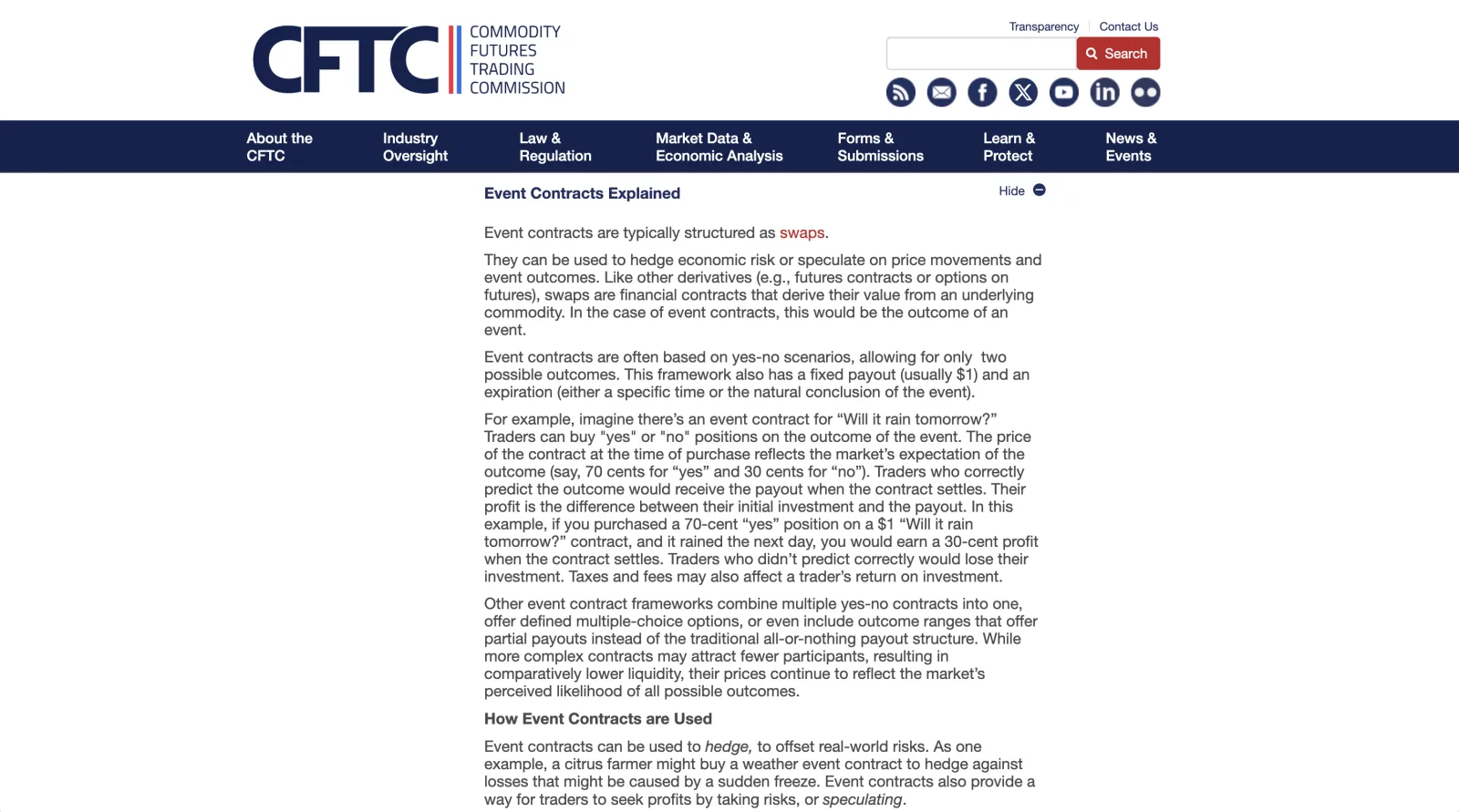
An event contract is a derivative whose value comes from the outcome of an event rather than the price of an asset. The US regulator puts it plainly:
"Event contracts are often based on yes-no scenarios, allowing for only two possible outcomes. This framework also has a fixed payout (usually $1) and an expiration (either a specific time or the natural conclusion of the event)." — CFTC, Understanding Prediction Markets and Event Contracts
Two outcomes. A dollar at stake. A deadline. That is the entire instrument — which is why it is easier to reason about than most things in trading.
Why does the price equal the probability?
Because a contract pays exactly $1 if it resolves yes and $0 if it resolves no, its price can only sit between those two numbers — and where it sits is the market's collective estimate of how likely "yes" is.
The CFTC uses this example: on a "Will it rain tomorrow?" contract, "the price of the contract at the time of purchase reflects the market's expectation of the outcome (say, 70 cents for 'yes' and 30 cents for 'no')." Buy yes at 70 cents, and if it rains you earn 30 cents when the contract settles.
So a market at 70 cents is not "cheap" or "expensive". It is a 70% probability with a price tag attached. And because it trades continuously, that probability updates in public every time new information arrives.
| Contract price | What the market is saying | Payout if correct | Loss if wrong |
|---|---|---|---|
| 8¢ | ~8% chance | 92¢ per contract | 8¢ per contract |
| 30¢ | ~30% chance | 70¢ per contract | 30¢ per contract |
| 50¢ | Genuine coin flip | 50¢ per contract | 50¢ per contract |
| 70¢ | ~70% chance | 30¢ per contract | 70¢ per contract |
| 92¢ | ~92% chance | 8¢ per contract | 92¢ per contract |
Read the last two rows carefully. A 92-cent contract is usually right and pays almost nothing when it is. That asymmetry is the whole game, and it is why "high probability" is not the same as "good trade".
Who decides whether you were right?
The settlement source is written into the contract before you ever open a position, and it is a government agency — not the exchange, and not anyone's interpretation.
| Market | What it settles on | Source agency | Contract terms |
|---|---|---|---|
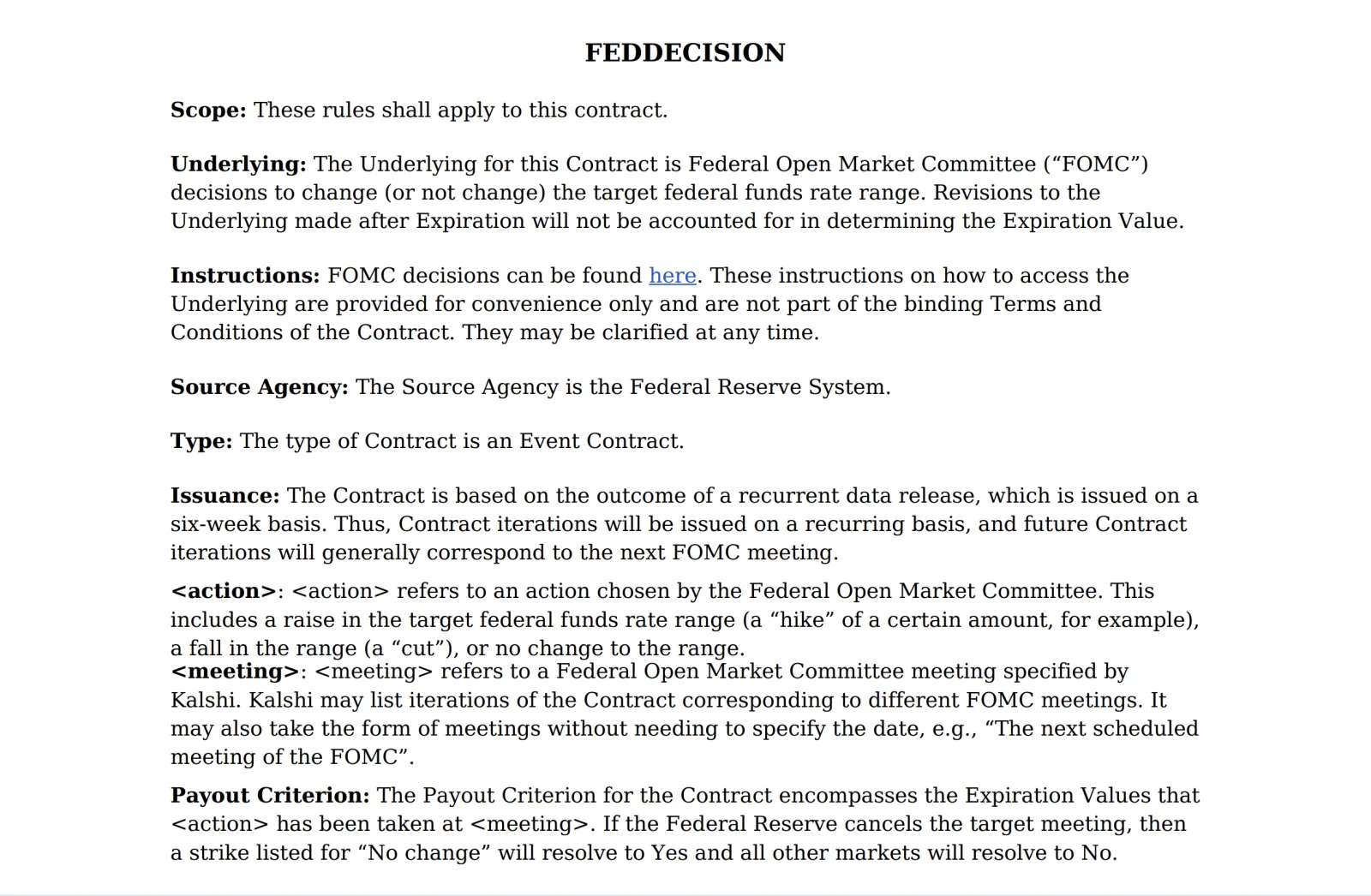
| Fed decision | The FOMC rate decision | Federal Reserve | FEDDECISION.pdf |
| Inflation | Year-over-year CPI, all items | Bureau of Labor Statistics | YOYCPI.pdf |
| Jobs numbers | The monthly payrolls release | Bureau of Labor Statistics | PAYROLLS.pdf |
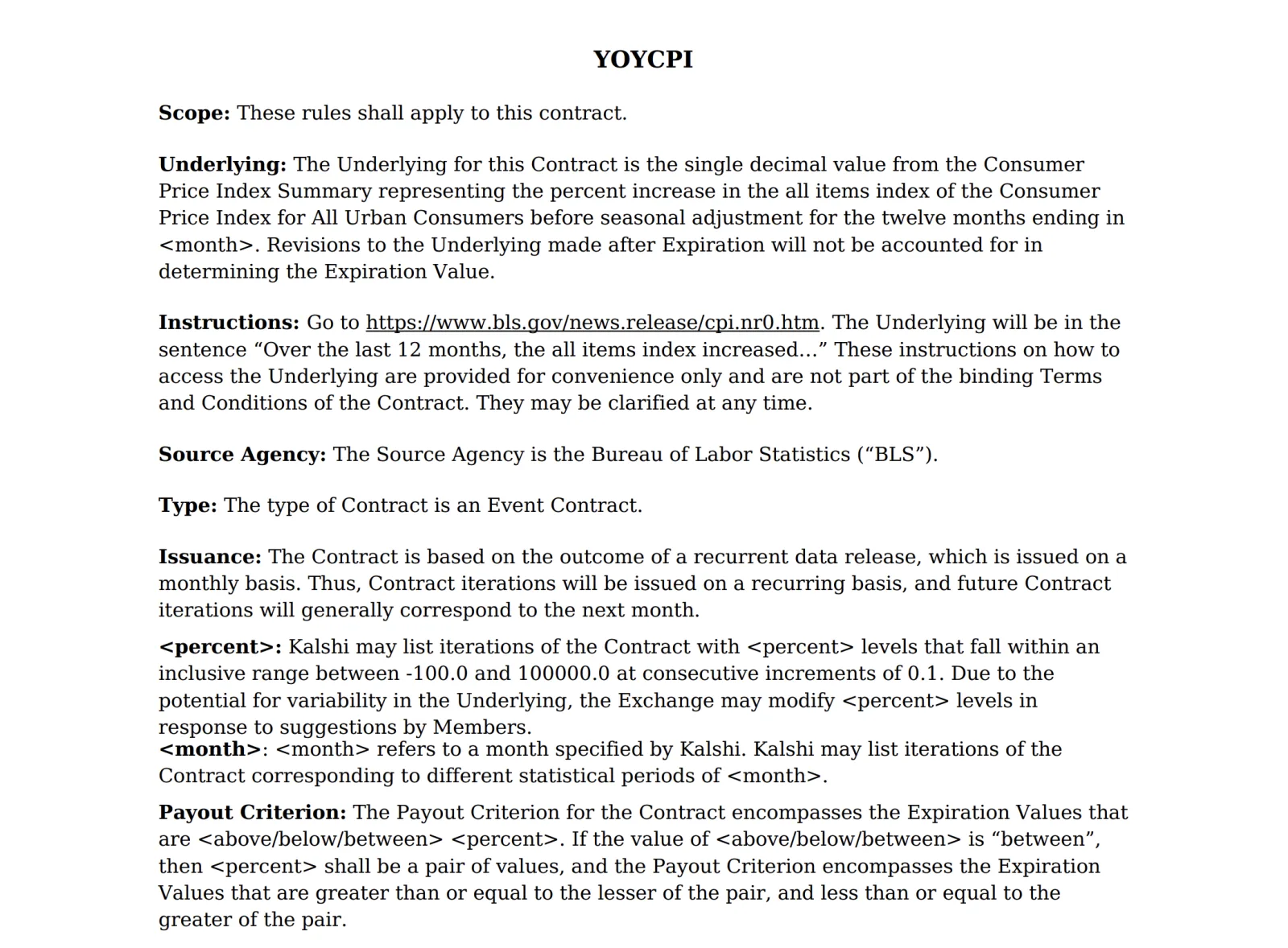
Those documents are public and you can read them before you trade. The CPI contract, for example, names the exact sentence it settles on: "Over the last 12 months, the all items index increased…" — and sets the last trading time at 8:29 AM ET, one minute before the data drops.
The same documents carry a rule most people never think to look for:
"Persons who are employed by any of the Source Agencies are not permitted to trade on the Contract. Persons who hold any material, non-public information on the Underlying are not permitted to trade on the Contract."
Insiders are barred in the contract terms themselves, not in a marketing promise.
Is this just gambling with a different name?
No, and the cleanest answer is the regulator's rather than mine. On a CFTC-regulated exchange, the venue is not on the other side of your trade:
"CFTC-regulated exchanges, brokers, or other intermediaries that provide access to prediction markets do not take a side of the trade. They provide a platform for trading and are not competing against you." — CFTC
That is the structural difference, and it is not cosmetic. A sportsbook earns when you lose — its revenue is your loss. An exchange earns on volume regardless of direction. Two opposite business models that can look similar from the outside.
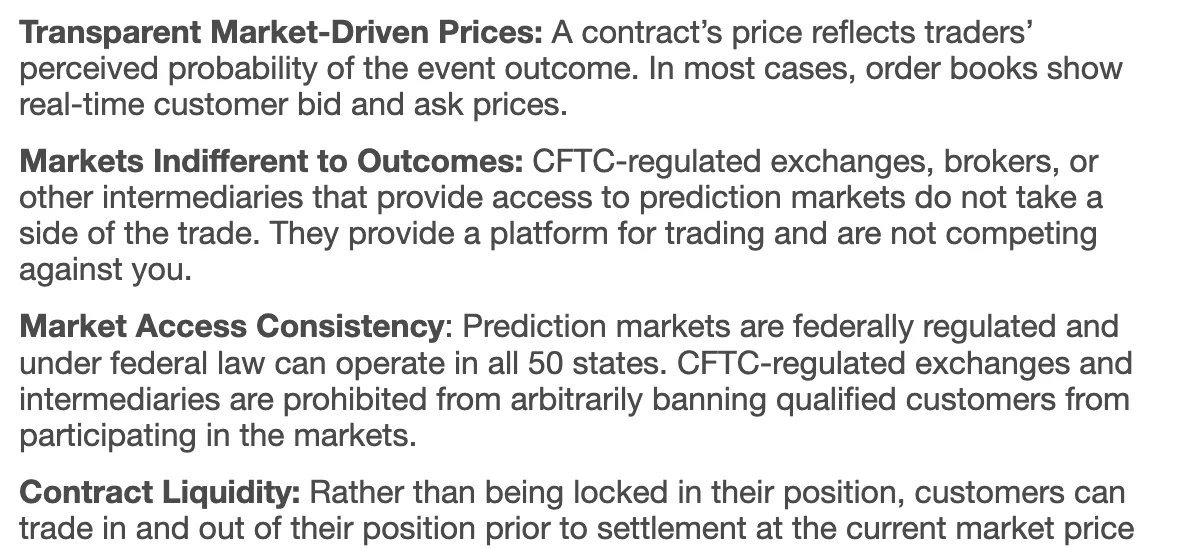
There is a second difference in that same screenshot, and it matters in practice: you are not locked in until the event happens.
"Rather than being locked in their position, customers can trade in and out of their position prior to settlement at the current market price to lock in gains or limit losses."
If the story changes halfway through, you can act on it. That is trading behaviour, not a wager sitting on a slip.
How new is this?
Not new at all — which surprises most people who met the category through crypto.
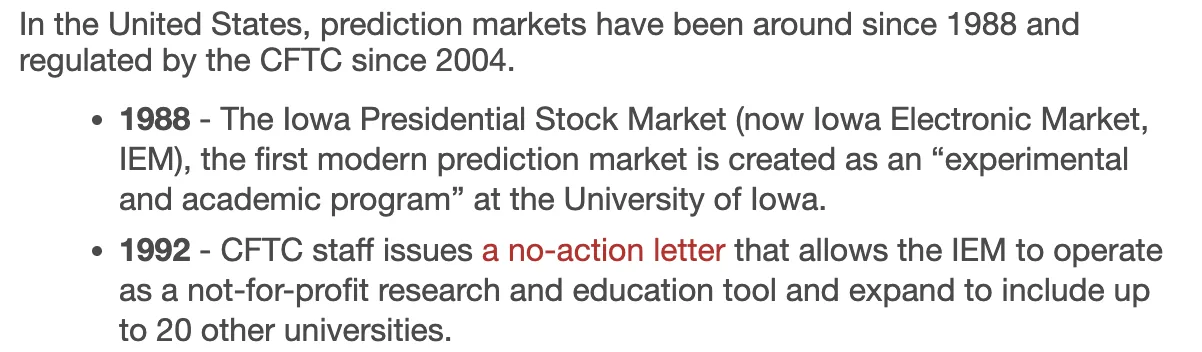
"In the United States, prediction markets have been around since 1988 and regulated by the CFTC since 2004."
The first modern prediction market was the Iowa Presidential Stock Market in 1988, created as an academic program at the University of Iowa. The CFTC approved the first designated contract market offering binary options in 2004. What changed recently is liquidity and public attention, not the legal foundation.
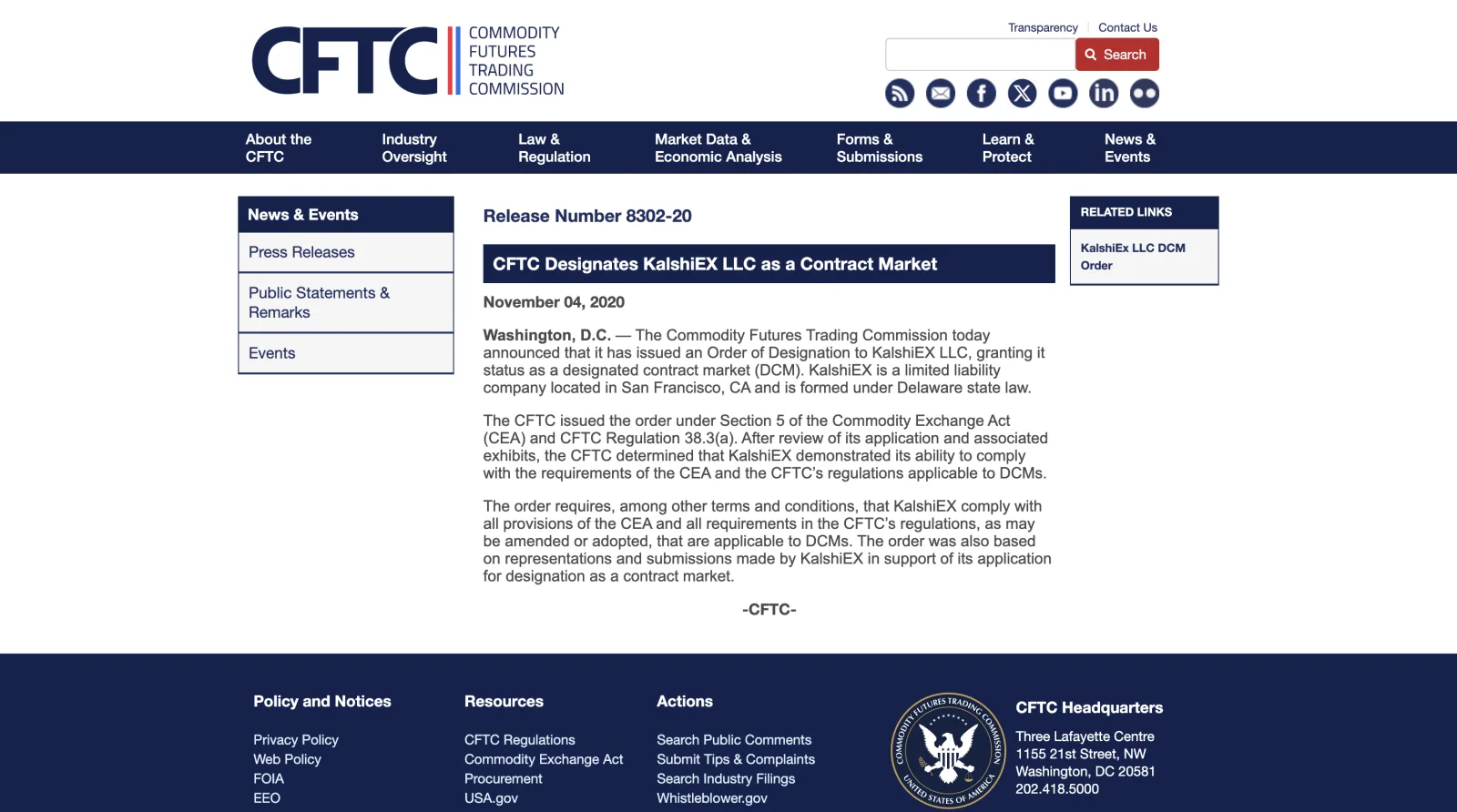
Kalshi itself has been a designated contract market since November 4, 2020, when the CFTC "issued an Order of Designation to KalshiEX LLC, granting it status as a designated contract market (DCM)" (CFTC Release 8302-20).
Where I trade this
I use Kalshi for event contracts, and I have used the same account for perpetuals — the walkthrough of that side of the platform, with a real position opened start to finish, is in my Kalshi Perpetuals Review.
One thing worth knowing before you open the app: the market list shows each outcome as a percentage, not in cents. It is the same number in a different coat. A market quoted at 87% is a contract you buy at 87 cents, and it still pays $1 if it resolves yes. If you learned the instrument as "70 cents means 70 percent", the app has simply done that conversion for you.
Here is the Fed rate-cuts market as it looks in the app. Three separate yes-or-no questions — exactly 0 cuts, exactly 1, exactly 2 — each with its own price, and the crowd putting 87% on "no cuts at all":
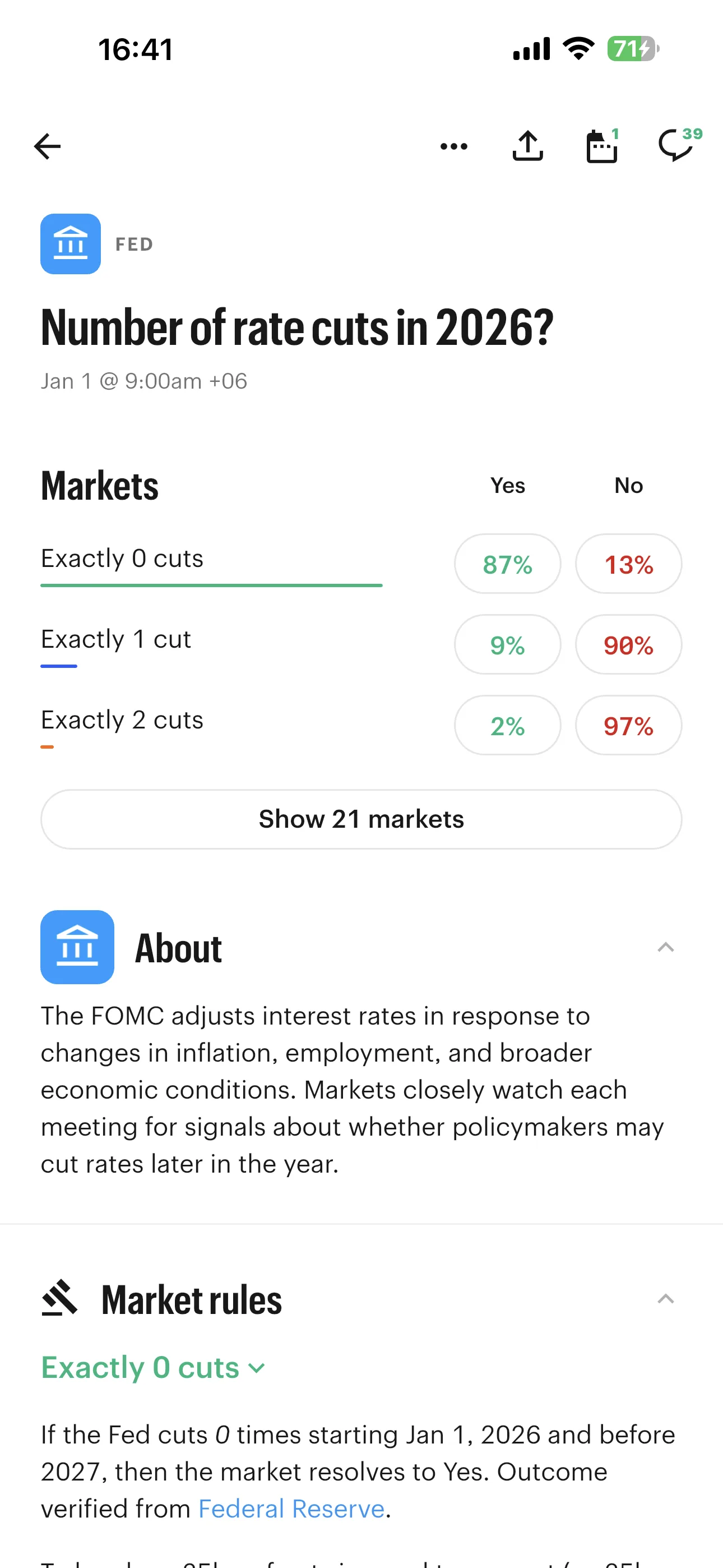
Scroll down that same screen and the app prints the settlement rule in plain language: "If the Fed cuts 0 times starting Jan 1, 2026 and before 2027, then the market resolves to Yes. Outcome verified from Federal Reserve."
That last sentence is the whole trust model, sitting in the interface where you cannot miss it. You do not have to go dig out the contract PDF to find out who decides — though the PDF is there, and it says the same thing in legal language.
📈 Open a Kalshi account with my link — new users who sign up and trade $50 get a bonus. Event contract trading carries risk and a position can settle worthless.
The honest limits
These markets are not a crystal ball, and the regulator's own wording is deliberately hedged:
"when everyone's predictions and knowledge are combined, prediction markets can sometimes forecast event outcomes better than polling or other forms of forecasting."
Sometimes. A 70% market is wrong roughly three times out of ten — and it is supposed to be. If it never lost, it would not be priced at 70.
Beyond being wrong about the outcome, there are three ways to lose while being broadly right:
- Timing. You can be correct about the eventual result and still be stopped out by the price swinging first.
- The spread. On thinner markets the gap between bid and ask eats into a thin edge.
- Fees. Kalshi charges a quadratic trading fee that scales with the contract price; on high-probability contracts it consumes a meaningful share of a small expected profit.
The CFTC's own guidance is blunt about the frame to use: "All speculation involves risk," and you should "only trade with risk capital, or money you can afford to risk after living expenses and other savings needs have been met."
Sources
- CFTC — Understanding Prediction Markets and Event Contracts (accessed August 24, 2026)
- CFTC — Release 8302-20, KalshiEX LLC designated as a contract market, November 4, 2020
- CFTC — Release 9240-26, BTCPERP order for approval, May 29, 2026
- Kalshi contract terms — FEDDECISION · YOYCPI · PAYROLLS
⚠️ Disclosure & risk. This page is part of a paid partnership with Kalshi and contains affiliate links. I may earn a commission if you sign up through them, at no extra cost to you. Nothing here is financial, investment, legal or tax advice. Event contracts carry risk: you can read a situation correctly and still lose on timing, spread or fees, and a position can settle worthless. Never trade with money you cannot afford to lose. Do your own research.
18+ only. Restrictions and eligibility requirements apply. Event contract trading involves significant risk and is not appropriate for everyone. Kalshi products are not available in all jurisdictions. See kalshi.com/regulatory for more information.
Register via my link
Open a Kalshi account — trade $50 to get a bonus
Frequently asked
What is a prediction market?+
An exchange where you trade the outcome of a real-world event rather than the price of an asset. The traded instrument is an event contract, structured as a yes-or-no question with a fixed payout, usually $1, and an expiration.
Why does a 70-cent contract mean a 70% probability?+
Because the contract pays $1 if it resolves yes and nothing if it resolves no. The price therefore sits between 0 and 100 cents and reflects what the market collectively believes the chance of "yes" to be. At 70 cents, buyers are risking 70 to win 30.
Are prediction markets legal in the US?+
Event contracts on a CFTC-regulated exchange are federally regulated. According to the CFTC, "prediction markets are federally regulated and under federal law can operate in all 50 states." Kalshi products are not available in all jurisdictions — check eligibility before you sign up.
How is this different from a sportsbook?+
A sportsbook takes the opposite side of your position and profits when you lose. A CFTC-regulated exchange does not take a side of the trade and earns on volume. You can also exit an exchange position before the event resolves, which a settled wager does not allow.
Who decides the outcome of a Kalshi market?+
A source agency named in the contract terms before you trade. Fed decision markets settle on the Federal Reserve; inflation and jobs markets settle on data published by the Bureau of Labor Statistics.
Can insiders trade these markets?+
No. The contract terms bar anyone employed by the source agency and anyone holding material, non-public information on the underlying.
What can I actually trade besides the Fed?+
Inflation prints, the monthly jobs report, and a wide catalogue of other economic, political and cultural markets. Every macro number that moves portfolios tends to have its own market with its own price.
Want a review like this for your project?
YouTube review + Telegram + an evergreen blog article — EN · ES · RU-CIS markets. Real audience, verifiable results.